Tag Archives: cooking

How to Steam Artichokes, or, Steamed Artichokes with Two Perfect Sauces

As artichokes make their springtime debut, I would like to share a life-changing tip with you.  Or at least a tip that will save you half an hour every time you steam artichokes.

I don’t know that I have properly thanked the friend who serves these artichokes at his house (just casually, as if they’re not miraculous) for bringing them into my life.  I should.  Because here’s the ray-of-light epiphany he helped me to see: You don’t have to steam artichokes whole.  You can cut them first.  They cook faster.

So, ok, this may have occurred to you already.  But it had not occurred to me.  Ever.  And I am giddy with the newfound ability to serve artichokes for dinner on a whim.

You do have the cut them first, and you could trim the outer leaves or drop them into lemon water or whatever you want to make them pretty.  But all you really HAVE to do is scoop out the furry choke with a spoon, like so:And then chop each half into quarters (so each artichoke is cut into eighths in the end), steam them for 20-30 minutes, depending on their size, and serve them with my friend’s special secret sauces.  Continue reading Steamed Artichokes with Two Perfect Sauces

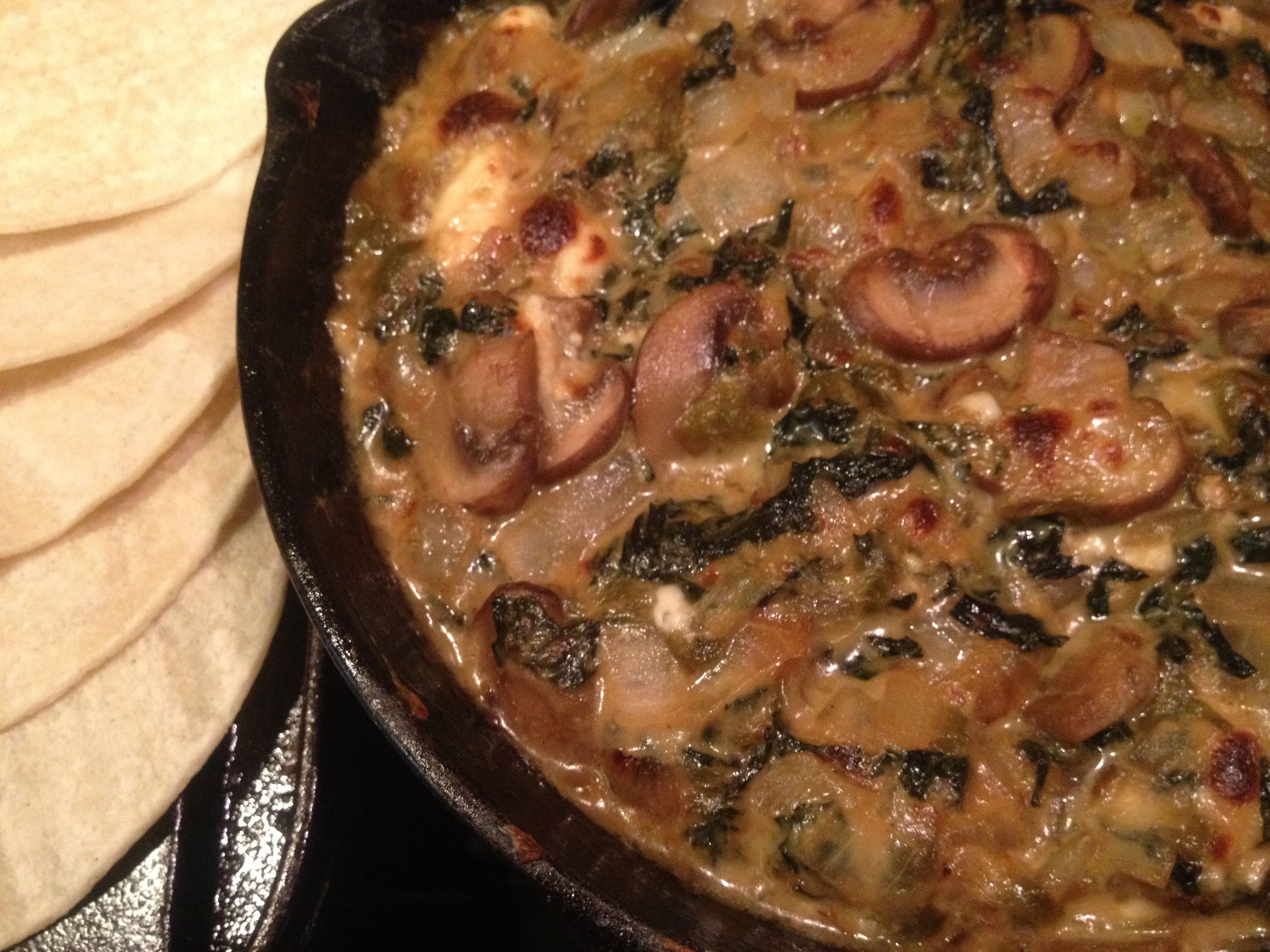
Queso Fundido with Mushrooms, Greens, and Chiles

So, those chiles.

They arrived in Seattle lovingly packed and frozen, straight from the Santa Fe farmers market.  Someone who loves me seeded the roasted chiles and pulled them apart into strips, a painstaking labor.  I had to do right by them.

There’s this little taqueria in Santa Barbara called La Super-Rica that became famous as Julia Child’s favorite taco joint.  There is always a line down the block.  There are a lot of great tacos in that part of the world, and some of my personal favorites actually come from Reyes Market in Carpenteria, but La Super-Rica makes one dish that I love.  Love.  They call it “rajas,” a name referring to the roasted strips of poblano pepper, but those peppers are also smothered in salty cheese.  You scoop them up with a warm tortilla and let the grease run down your arms.  Luckily Seattle is not very close to Santa Barbara, so this is an occasional indulgence.

I’m calling my version “Queso Fundido,” which is a Mexican dish of melted cheese enhanced with bits of meat or vegetables or spicy peppers, meant to be scooped up with chips or wrapped in corn tortillas.  As I like to do, however, I’ve inverted the traditional proportions, starting with a pan chock-full of vegetables and stirring in just enough cheese to make the dish come together.  And we loved it.  Continue reading Queso Fundido with Mushrooms, Greens, and Chiles (click for recipe)

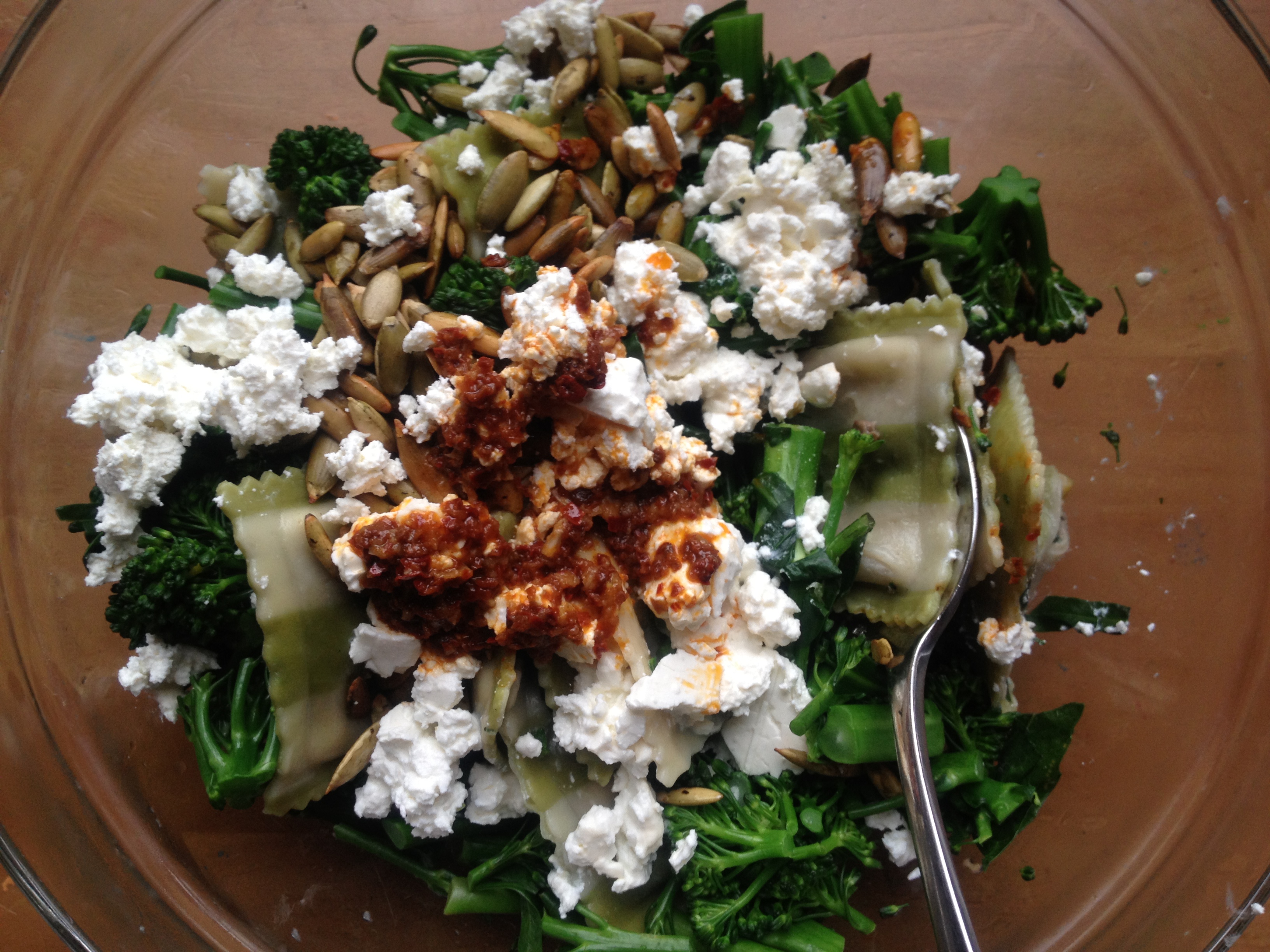
Broccoli Salad with Ravioli, Feta, and Lemony Harissa Dressing

I have this little food-related fantasy right around lunchtime some days.  I thought for about two seconds about whether I should share it with you all, but then I realized, YOU’RE the one reading a food blog, you must be at least as obsessed with food as I am.  So I figure you must have plenty of food fantasies of your own.  Here’s mine, which may be most recognizable to stay-at-home parents of very small children who end up eating PB&Js for lunch with one hand while holding a baby in the other arm: a drive-through (or delivery!) deli counter, featuring healthy, hearty, fresh, delectable salads.  Or, since it’s make-believe anyway, let’s just go ahead and say great salads that magically appear in my refrigerator as soon as I get hungry.

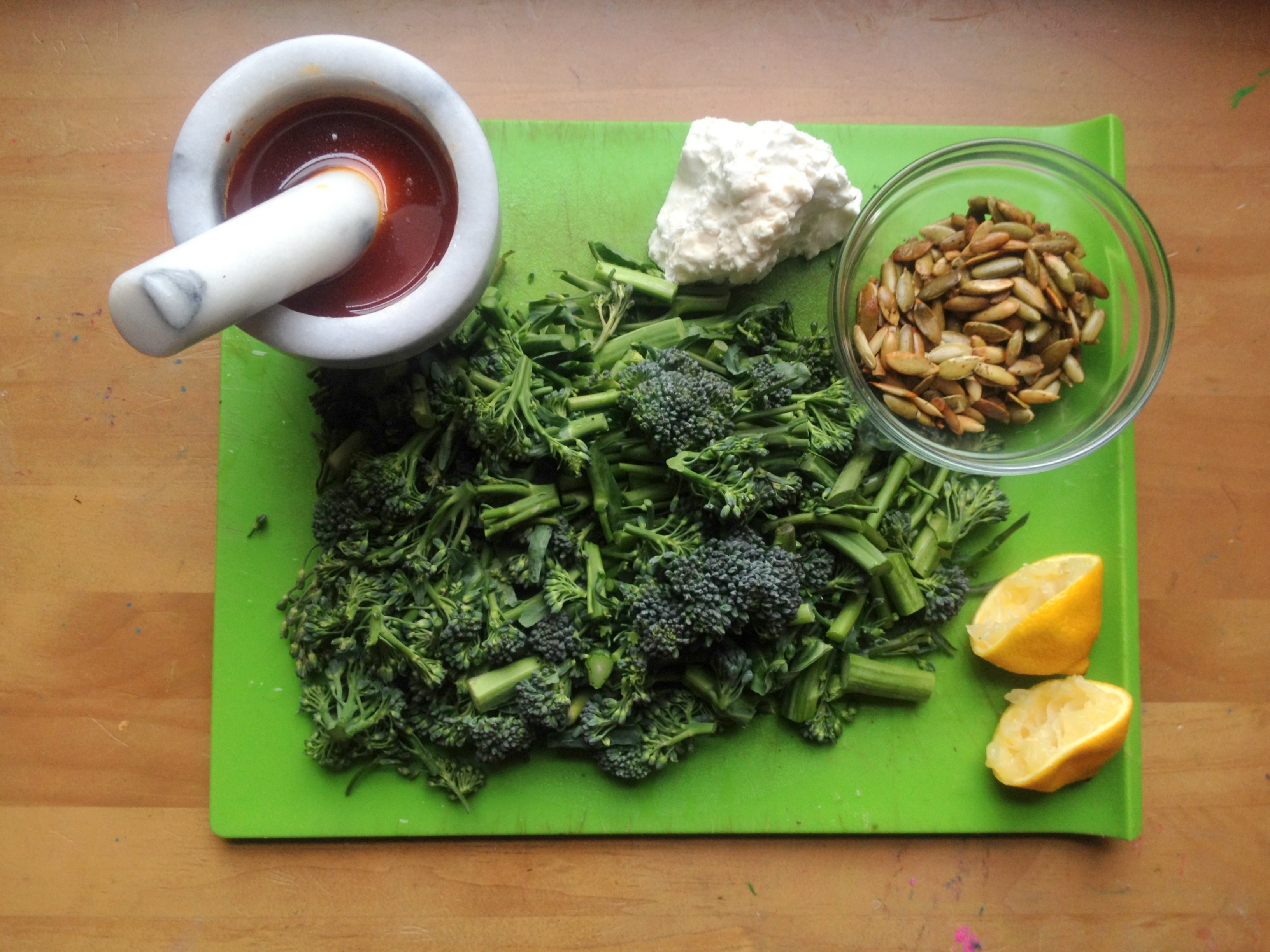
There are a few places near me that feature impressive arrays of pre-made salads, but they’re not always as good as they look.  And I want good.  So when I can manage to plan in advance, I like to make a great salad for dinner and then stock my fridge with the leftovers for weekday lunches.  This is just such a salad.  Whether you eat it at your desk or during your baby’s 10-minute nap, I recommend following it with one of those pixie tangerines that are sadly about to disappear until next year.  Almost like magic.This salad is adapted from Heidi Swanson’s Super Natural Every Day.  You can play with the proportions, using more ravioli for more of a pasta salad or less for more of a broccoli salad (which I prefer).  As for the dressing, we have tried many prepared harissa pastes and currently use the Tunisian brand Les Moulins Mahjoub (it looks like this and I buy mine at The Spanish Table), but if you have another favorite I’d love to hear about it! Continue reading Broccoli Salad with Ravioli, Feta, and Lemony Harissa Dressing (click for recipe)

Southwestern Frittata with Peppers, Black Beans, and Cheddar

Speaking of glorified scrambled eggs, a frittata is one of my favorite quick dinners.  (Although of course it would not be out of place at an elegant brunch. You know, should you have the occasion to host or attend an elegant brunch.  Around here on weekends it’s more of a race to see if I can just snag a pancake before the kids eat them all.)  A frittata has a significant advantage over scrambled eggs when it comes to dinner, in fact, because it can be made ahead and served at room temperature, or even cold.

Some of my favorite people went tootling around New Mexico recently, and knowing that they were in the land of chiles left me dreaming of the flavors of the Southwest.  They hadn’t yet come back to deliver my stash of frozen roasted Alcalde chiles, so I was stuck making this frittata with ingredients available to ordinary mortals.

But now those chiles are in my freezer.  What should I do with them?! They’re like gold. Or at least truffles.

Anyway.  Back to the I’m-not-in-Santa-Fe frittata.  I knew that I wanted to make a thick frittata, packed full of vegetables and a big scoop of drained pico de gallo salsa.  I was a little worried about getting my frittata to cook through, so I turned to the experts on nitpicky culinary concerns, Cook’s Illustrated.  And, as usual, they had good advice for me: cook the eggs as if you are scrambling them until they are nearly set, then finish them under the broiler.  Which I did. Continue Reading Southwestern Frittata with Peppers, Black Beans, and Cheddar (click for recipe)

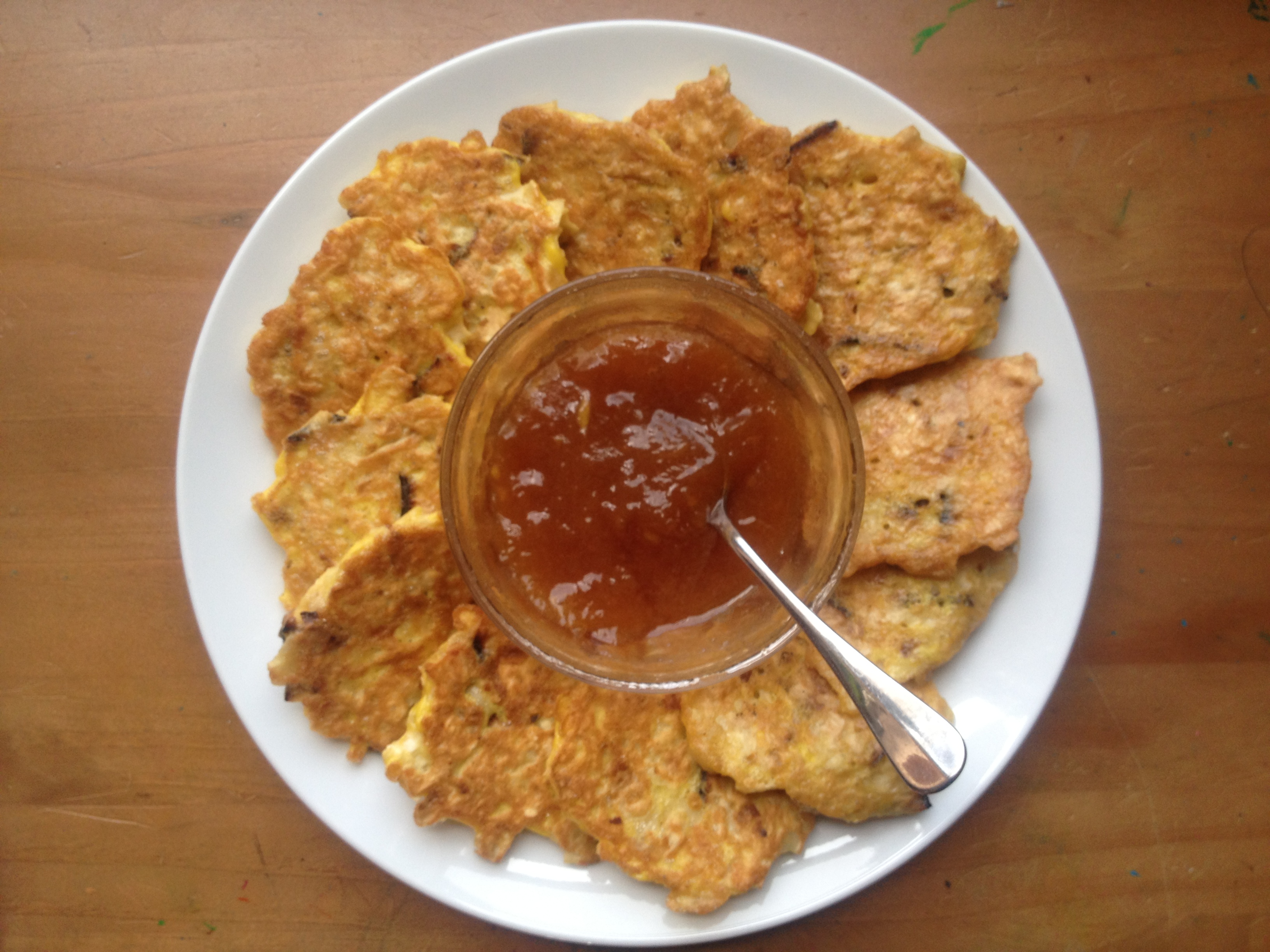
Matzo Brei

Lest you think that I am only posting this recipe in order to get away with eating scrambled eggs again, I would like to start by clarifying that matzo brei (rhymes with “fry” and, hey!, also means “fried”) is a traditional Passover meal.  Some people eat it because they are eating matzo (matzoh/matzah!) in place of leavened bread in observance of Passover.  The rest of us eat it because we have a box of matzo in the house and would prefer to use it up this year.  Either way, these eggy pancakes make an appealing blank slate for sweet or savory sauces, and get you out of eating boxed matzo in its dry and un-fried form.

I’d like to tell you that this was my own Bubbie’s recipe, but actually it came from Bon Appetit.  Growing up, my family’s matzo brei was more of a scramble, and if I recall correctly it involved fried salami as well (is THAT kosher?).  This recipe is more refined, more symmetrically shaped, and more vegetarian.

Matzo brei is traditionally a breakfast dish, but breakfast for dinner is never a bad idea.  You can take these in a sweet direction with jam, powdered sugar, or syrup, or you can spice things up; we liked them with a harissa spread.  But my personal favorite topping was our homemade plum-ginger jam.  You could easily replicate it by pureeing a pound of pitted plums and boiling them down with a couple of teaspoons of grated ginger and sugar to taste (I further sweetened our jam to use as a sauce here).  Isn’t that good?  You’re welcome. Continue reading Matzo Brei (click for recipe)

How to Make Homemade Organic Vegetable Broth for Free

Well, almost free.

I like to make my own broth for many reasons.  It tastes better, I can choose how to salt it, it’s environmentally friendly, and it doesn’t sit on a shelf in plastic for an indeterminate amount of time before it arrives in my soup pot.  But, let me be honest, the biggest reason I make my own broth (or stock, maybe, if you want to get technical) is that it’s irresistibly cheap.

Buying mostly organic produce is good for the environment and, I believe, for my family’s health.  But the price tag still rankles a bit, especially here in Seattle where the only things that appear to grow effortlessly are rosemary and moss.  Making my own broth allows me to essentially use my vegetables twice: I eat the trimmed part the first time around, and save the peelings for the stock pot.  At $3.50 a quart, I’m saving over twenty dollars every time I make my own broth.  If I do it once a month, the savings really add up over the course of a year.  Of course, you might not eat as much soup as we do…but still.  It makes me feel better about how much I pay for organic produce.

[UPDATE: Many of the comments below mention composting veggie scraps or feeding them to the chickens.  This, of course, is their third and final use after you have boiled them for stock!]

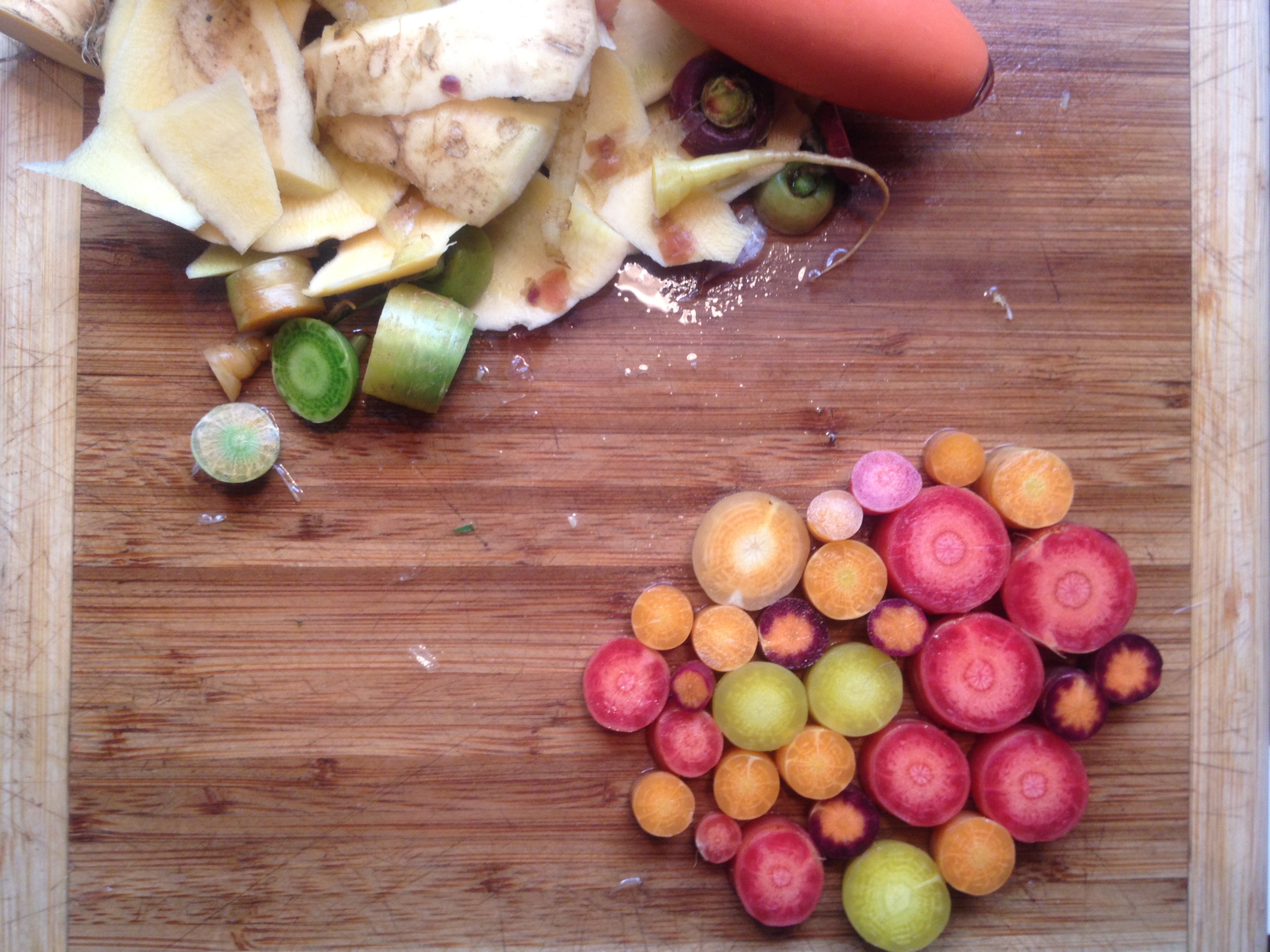
The basic method is to chop your selected organic vegetable trimmings into 1-2” pieces and save them in a bag in your freezer.  (I wouldn’t do this with non-organic vegetables, because I’d be concerned about concentrating the pesticides that are in the peels.  This is my completely unscientific personal opinion.)  Add to the bag over time.  When it’s full, put everything in a pot, cover it with water, add some seasonings, and simmer for 30-45 minutes.  Add salt until it tastes like something you’d like to drink by the mug.  Strain and use your broth, or freeze it for later use.  Get a new freezer bag of trimmings started and repeat.

The only mental effort required is the contemplation of whether the trimmings you have before you will taste good in your broth.  Some are easy: Carrots? Yes.  Broccoli rabe?  Probably not.  Turnips?  Trick question!  They’re great.

You want to aim for a balance of flavors in your stock pot.  For me, the essentials are onion, celery, and carrots (or another sweet vegetable, like winter squash).  If I don’t have some of each in my frozen mix, I will sacrifice a whole onion or a few stalks of celery to balance out the flavors.  Beyond, that, though, the sky’s the limit.  I have tried to list some of my favorites (and a few un-favorites) below, but if you want an opinion from me and/or your fellow readers about whether a particular vegetable would be good in a broth, please just ask in the comments.

One more note: this process has the added benefit of giving you seasonally-flavored broths.  The vegetables I’m cooking this month are going into the freezer, and what goes into the freezer ends up in the stock, which means that my stocks reflect current seasonal flavors.  Perfect, because my soups usually do as well.  It’s a beautiful cycle.  When cooking in the summer, I usually do want a light broth with corn and tomato flavors, and in winter I am glad to have a rich one full of mushrooms, root vegetables, and winter squash.

Continue reading How to Make Homemade Organic Vegetable Broth for Free (click for recipe)

A Delicious Cracker: Homemade Matzo with Olive Oil

Tonight is the first night of Passover, so we are baking matzo (matzoh? matzah! I can never decide which spelling to use) this morning instead of challah (hallah!).  Inspired by a sweet post on Gourmandistan, I took their advice and didn’t use their recipe, instead opting for one that Mark Bittman published in the NY Times a couple years ago.  Already untraditional in its use of olive oil and salt, I took the glad-not-to-be-actually-fleeing-Egypt spirit one step further and sprinkled the tops of some with the outstanding fennel and nigella salt from SugarPill and others with a dukkah blend from World Spice.

The result? Truly delicious crackers.

The recipe admonishes you to roll the dough paper-thin.  And when you say paper-thin, I say pasta roller.  That did actually work quite well, but I will also share that the much thicker rounds that my three-year-old rolled out by herself were equally delicious and only marginally less crispy.  So this is not a fussy dough.  Enjoy yourself.  And once you try these, you may decide to make them a year-round staple.  I am already thinking of the dips I want to serve these with after Passover is over and I can avoid the spelling conundrum by simply calling them “flatbreads.” Continue reading Homemade Matzo with Olive Oil (click for recipe)

Quinoa Chili with Red Peppers

I ran into a neighbor the other day who was out walking with her three kids.  The youngest is a new baby, just about the same age that my new baby was when I decided that something had to give and we’d just have to eat scrambled eggs for the rest of time.  (I’d like to be able to say that I gave up on cleaning as well as cooking at that time, but, to be honest, cleaning was never really my thing.)

I offered to bring dinner by, of course.  I probably should have offered to come over and do eight loads of laundry instead, but I imagined that my casual acquaintance wouldn’t take me up on that offer.  (Or maybe I’m just telling myself that because I’d rather cook than do laundry any day.  If someone near and dear to you has a baby, though–especially a third baby–you should TOTALLY offer to do their laundry.  They need all the help they can get.)

I’m not necessarily recommending this chili as the ideal food for new parents.  It has everything some nursing moms try to avoid: spice, garlic, beans, onions.  Some might prefer a soothing lentil soup, or those quinoa cakes, or a tofu enchilada casserole.  But this chili is quick to cook and makes plenty to share.  And my neighbor was game.

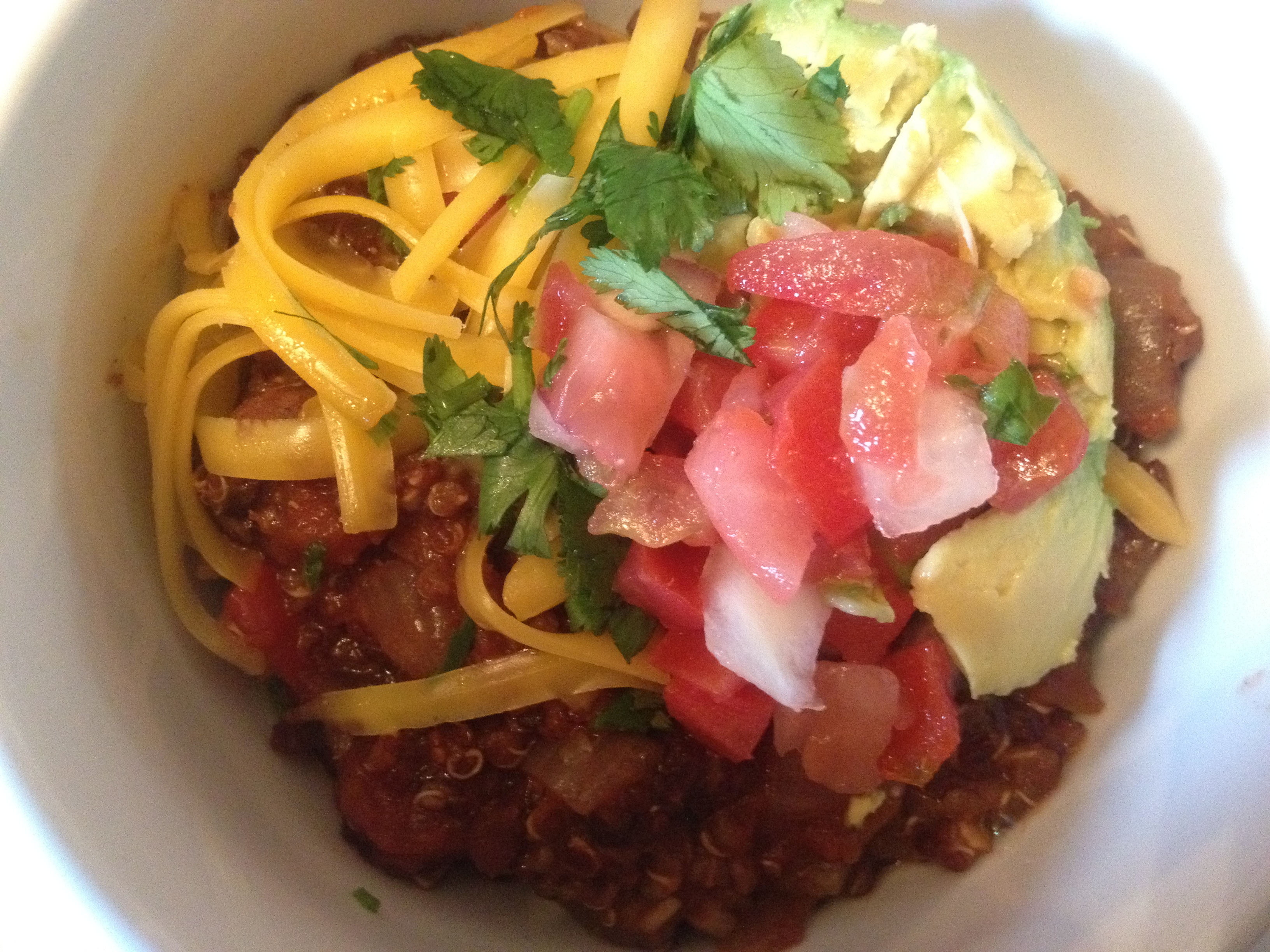
It’s a recipe from the the “red” section of the Ripe cookbook (also the source of that Dal with Curried Red Onion Jam).  And when I read the headnote I knew that this recipe and I were meant to be.  Because it says that Ripe author Cheryl Sternman Rule adapted the recipe from one that she developed for Eating Well magazine way back when–and you know that she has GOT to be talking about my favorite wheat berry chili.  Except that quinoa cooks in 15 minutes instead of an hour and 15 minutes.  A brilliant idea for a busy mom on a busy day.  I kept my favorite elements of each recipe, of course, cooking the quinoa longer for more chew than crunch, happily piling in the red pepper, replacing red beans with homemade black beans, and squeezing in a few limes at the end. Continue reading Quinoa Chili with Red Peppers (click for recipe)

Bittersweet Chocolate and Dried Apricot Cookies

There has long been a sweet little cafe in Seattle called Macrina Bakery. It has a few outposts now, and any of them are fortunate places to find yourself at lunchtime or when you need an afternoon pick-me-up.  Or for breakfast, of course.  Or whenever.  Freshly baked breads, good coffee, great pastries, a handful of equally decadent savory options to round out the offerings.  And lucky for us, they published a cookbook.

I was in search of a unique chocolate chip cookie.  Do yourself a favor and don’t waste time idly Google-ing “unique chocolate chip cookie.”  Sometimes the internet is useful, and sometimes it’s not.  I needed a cookbook.

My cookbook collection is largely geared toward the savory side of life, it turns out.  What are your favorite baking books?  I picked up one of the few I own, Leslie Mackie’s Macrina cookbook, and luckily it came through for me.

Chopped bittersweet chocolate and dried apricots certainly contribute generously to this cookie’s appeal.  But there’s another deeper, darker secret: the mere half teaspoon of finely ground espresso.  It lends a rich, difficult-to-place depth to the cookie’s flavor, firmly cementing its status as THE unique chocolate chip cookie I was looking for.

One friendly tip.  The recipe instructs you to chill the dough before baking it.  That is not the kind of thing I like to do.  If you know me, you know that I do everything at the last minute, which means that when I make cookies they are going straight into the oven because I need them to be ready ten minutes from now.  But in the spirit of experimentation, I also set aside a bit of dough and baked it the next day.  The cookies were even better.  The flavor was a bit more caramelized, deeper.  The original cookies were good.  The chilled batch was amazing.

So hey, what’s your favorite baking book?  I like easy, unfussy, not insanely decadent.  I can certainly recommend the Macrina cookbook (and not just on the strength of this recipe; I’ve made some others, and had still others made for me, all great).  I also love Rustic Fruit Desserts, by Cory Schreiber and Julie Richardson, and I am looking forward to pulling that one out more come summertime.

Bittersweet Chocolate and Dried Apricot Cookies: In a large bowl, combine 2 1/2 c. flour, 1 tsp. baking soda, 1/4 tsp. salt, 1/2 tsp. finely ground espresso beans, 10 oz. chopped bittersweet chocolate, and 3/4 c. finely diced unsulfured dried apricots.  Cream 8 oz. (2 sticks) butter with 3/4 c. granulated sugar and 3/4 c. light brown sugar on medium speed for 5 minutes.  Add 2 eggs and 2 tsp. vanilla, scraping down the bowl as you go.  Add half of dry ingredients, mix until incorporated, then add other half and repeat.  Refrigerate the dough for one hour (or up to 4 days) if you can possibly wait.  Roll into 1″ balls, flatten slightly, and bake 8-10 minutes on parchment-lined sheets at 350, until the edges are golden brown.

Farro Bowl with Toasted Kale and Coconut and Curry-Roasted Tofu

This is a good bowl of food.  Savory, crunchy, a little sweet from the coconut, a little spicy from the curry paste.  Whole grains, crispy-chewy kale and coconut, bouncy roasted tofu.  I used farro because I happened to come across it while I was thinking about this recipe, but brown rice would be a perfectly acceptable substitute.  And if you have ever made kale chips, you have some idea of the magic that’s going to happen here.This combination is based on the kale salad in Heidi Swanson’s Super Natural Every Day, but with a bit more kale, less oil, and with tofu added to make it a more complete meal.  It sounds a little complicated, but once the grains were cooking, the rest came together quickly.  The results were deeply flavorful.  This is one of those recipes where the final dish seems to exceed the sum of its parts. Continue reading Farro Bowl with Toasted Kale and Coconut and Curry-Roasted Tofu (click for recipe)