Category Archives: Vegetables By Themselves

Kale Salad with Apples, Currants, and Gorgonzola

It’s time for another hearty vegetable salad, although if you want this one last long enough to have for lunch the next day you had better at least double the recipe. It’s that good, and beautiful to boot.

Raw kale salads are run-of-the-mill these days, but this salad hails from an era when even people like us were a little skeptical about eating raw kale. It is a “massaged” kale salad that appears to have been all over the internet in 2009 with earnest promises that massaging the kale with salt would break down the cell wells and render it so tender as to be virtually cooked.

Somehow, however, this precise salad didn’t come to my attention until today, when my friend sang its praises and urgently requested the recipe from his sister via text message. Thank goodness. And now I’m sharing it with you in case it also escaped your notice in 2009.

As far as I can tell, this recipe is originally from Feeding the Whole Family by Cynthia Lair, and she got it from a colleague of hers at Bastyr University. If you want a demo of the technique, you can watch her video here, but it’s pretty basic: add salt to kale ribbons and gently knead and squeeze it in for a couple minutes, then add a ton of other delicious stuff, too.

Continue reading Kale Salad with Apples, Currants, and Gorgonzola (click for recipe)

Thai Greens and Tofu

I write an occasional home cooking column for my friendly neighborhood blog, and last weekend I told all my neighbors about a recipe that came from the nice folks at my favorite not-quite-a-restaurant (it’s really just a streetside stand), Little Uncle.

So I thought it was only fair to tell you, too.  Because we are going to be making this a lot at our house.  Partly because I bought a huge bottle of yellow bean paste, and this recipe requires 2 Tbs., so I have a lifetime supply (it’s like that beet powder!).  But mostly because it took 17 minutes (that was for the jasmine rice to cook), made the house smell divine, and yielded a savory-spicy-garlicky vegan bowl of goodness.

You can read my Capitol Hill Seattle post here, but just in case you don’t, here’s the important thing you’re missing: track down some mangosteens.  Yum, mangosteens.

You can also substitute chicken for the tofu, or make a greens-only version of this dish (pictured below) as one component of a bigger Thai meal.  More Thai recipes to follow, I think!  In the meanwhile, if you are in the mood for Thai flavors, you could also check out this Noodle Curry or this Green Fish Curry to hold you over.

Continue reading Thai Greens and Tofu (click for recipe)

How to Steam Artichokes, or, Steamed Artichokes with Two Perfect Sauces

As artichokes make their springtime debut, I would like to share a life-changing tip with you.  Or at least a tip that will save you half an hour every time you steam artichokes.

I don’t know that I have properly thanked the friend who serves these artichokes at his house (just casually, as if they’re not miraculous) for bringing them into my life.  I should.  Because here’s the ray-of-light epiphany he helped me to see: You don’t have to steam artichokes whole.  You can cut them first.  They cook faster.

So, ok, this may have occurred to you already.  But it had not occurred to me.  Ever.  And I am giddy with the newfound ability to serve artichokes for dinner on a whim.

You do have the cut them first, and you could trim the outer leaves or drop them into lemon water or whatever you want to make them pretty.  But all you really HAVE to do is scoop out the furry choke with a spoon, like so:And then chop each half into quarters (so each artichoke is cut into eighths in the end), steam them for 20-30 minutes, depending on their size, and serve them with my friend’s special secret sauces.  Continue reading Steamed Artichokes with Two Perfect Sauces

Kale Chips

Are kale chips so 2009?  I used to be in the kale chip vanguard, an evangelist for their crispy crunch and umami allure.  I sang their praises, shared the recipe (such as it is) with anyone who’d listen, made batch after batch.  But suddenly I keep hearing that kale chips have become as passé as the combination of sun-dried tomatoes and asparagus.  It is with great regret that I will have to give them up to keep abreast of current food trends….

Not really.  I don’t even really know what the current food trends are.  So, friends, two questions.  One, what are the current food trends?   And two, what do you put on your kale chips?

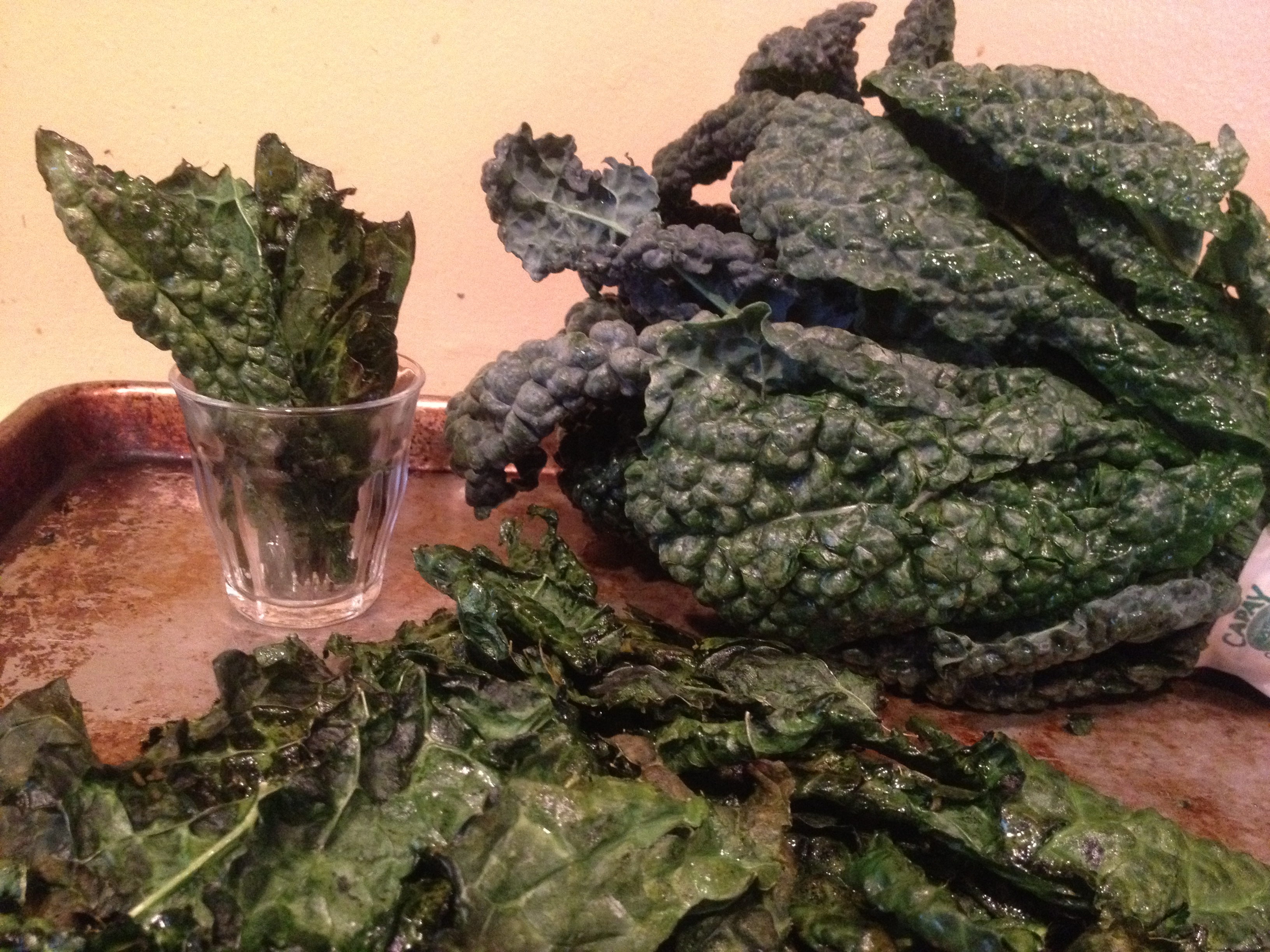
I have heard of all kinds of fabulous-sounding additions that could take your kale chip experience in many possible directions: sesame seeds, Parmesan, smoked paprika, cayenne, garlic powder, you get the idea.  But I usually just go with olive oil and salt.  I hesitate to call this a recipe because you can really do anything you want here as long as you dry out some kale in the oven until it’s crisp without burning it.  Any kind of kale.  I’ve made these chips with lacinato kale (pictured), green and purple curly kale, Red Russian–all great.  Wash and dry a bunch of kale and tear it into small or large pieces.  Rub with a little olive oil and salt and additional seasonings if desired.  Spread leaves in a single layer on two cookie sheets.  A relatively foolproof method is to bake the chips at 250 for 30-35 minutes, switching the top and bottom pans halfway through and watching closely near the end of the cooking time.  (Thanks, Bon Appetit in 2009!) Remove chips as they crisp and return the rest to the oven to finish cooking.

But IF you can’t wait half an hour for this magic, and IF you’re feeling daring and eagle-eyed, you can roast these chips at a much higher temperature (say, 450).  It goes without saying that they will cook, and burn, more quickly at a higher temperature.  On the other hand, they’ll be ready more quickly for you to gobble up like they’re going out of style.

Sweet Potato Chips

I occasionally see sensational headlines about how you can make potato chips in your microwave.  That is bunkum, I say.  I tried it out, just to be sure, and the results were as ridiculous as I expected.  I got cardboardy, chewy potato slices with some occasional hard spots.  My kids did eat them (I mean, I called them “chips,” so what’s not to like?), but they weren’t good.  And they took a while to make, what with having to check and remove “crisp” specimens then re-microwave the rest.  Luckily you can only make a plate at a time, so the damage was limited to half a potato.

You want chips without a deep fryer?  THIS is the recipe for you.  We do this with regular potato slices as well (I keep promising that potato chip pizza recipe), but for eating on their own these sweet potato chips are the best.  They crisp up right through, you can make two big trays at a time in the oven, and they are a sweet and salty side or snack.  Crunch, crunch, crunch. Continue reading Sweet Potato Chips (click for recipe)

Baked Sweet Potato Fries

End of the weekend.  A sweet one, full of friends, that left the kitchen a disaster.  Everyone’s gone, kids are sleeping, we’re talking in the kitchen.  I’m eating sweet potato fries.  Cold.  Off a cookie sheet.

Casually at first–there are only a few left, it seems easier than putting them away.  I absent-mindedly take another, wonder if we could just clean up next weekend instead. (Is that soon?)  Then I give the tray my full attention to peel up the last sticky, crispy, sugary bits of sweet potato.  No wonder my kids love these.

If your kids don’t get to them first, you’ll be glad to have these roasted sweet potato fries alongside a burger or sandwich of any sort, for an afternoon snack, or topping an untraditional soba or sushi rice bowl.  Or maybe, like me, you’ll find yourself eating them cold from the pan as dessert.

Baked Sweet Potato Fries: Cut sweet potatoes into batons of any size.  Place on a baking sheet and toss with olive oil and salt.  Roast at 450, checking every 10 minutes and turning them as they start to brown.  Remove when edges are crisp; smaller fries may be done before larger ones.  Total baking time depends on how thickly the sweet potatoes are cut.  Serve with ketchup, or maybe a garlicky aioli.

Roasted Cauliflower

Yesterday got me thinking about flavorful vegetarian cooking.  I have been a vegetarian (or, now, a mostly-vegetarian, with apologies to those who are offended by the concept) for my entire cooking life.  So I have never relied on meat to flavor my food.  What do I rely on?  Vegetables, heat applied to vegetables, fat, salt, spices and herbs.  I also know and revel in the range of textures and flavors that each vegetable can provide on the plate: a beet can be meltingly sweet and earthy or brightly crisp and bracingly imbued with lemon or ginger.  Fennel can be a licorice tangle of crunch, a whisper of greens in a salad, or carmelized to a sweet and savory mush that is barely haunted by anise flavor.  And I get excited every time I discover a novel way to cook a vegetable.

By way of illustrating the range of a humble vegetable, I thought I’d share a very simple but utterly delicious recipe for roasted cauliflower.  Compare it to this simple, creamy 5-ingredient Cauliflower Soup (cauliflower, onion, olive oil, water, salt).  Compare it to this Smoky Cauliflower Frittata.  You can take a cauliflower in a lot of directions.  But once it’s roasted, that’s pretty much the end of the line for a cauliflower in our house.  It often gets eaten off the sheet pan before dinner is even on the table.

Roasted Cauliflower: Chop one head of cauliflower (or two, if you want one left to put on the table with dinner) into medium florets, and chop the remaining stem into slightly smaller pieces.  If the leaves are large, chop them as well, otherwise leave them whole.  Pile onto a roasting pan, including the tiny bits–these will brown into delicious little salty bites.  Toss with olive oil and salt and roast at 450.  Turn with a tongs after 20 minutes, then every 10 minutes after that, until they are nice and brown on all sides (about 45 minutes total).  Hide from passers-by until serving.


Shaved Brussels Sprout Salad with Lemon, Pecorino and Red Onion

The other day I got to sneak away to one of Seattle’s year-round farmers markets for an hour with a friend.  I hadn’t been to a farmers market for a while and apparently felt that I had to make up for lost time.  I came home with some of my favorite hazelnuts, many pounds of potatoes, rutabagas and turnips, sweet crisp apples, a new supply of Nash’s field peas, and a big bag of Brussels sprouts.  Big.

I’ve had my eye on this salad for a while, and I’m happy to report that it did not disappoint.  The version below is adapted from the Food 52 website, and I’ve updated the recipe title to reflect my own preference for the order in which the flavors should dominate.  As always, one of the joys of cooking at home is that you get to tweak every dish to taste perfect to you.  Go ahead, pile on the cheese or leave the onion out altogether.  You’re the cook.

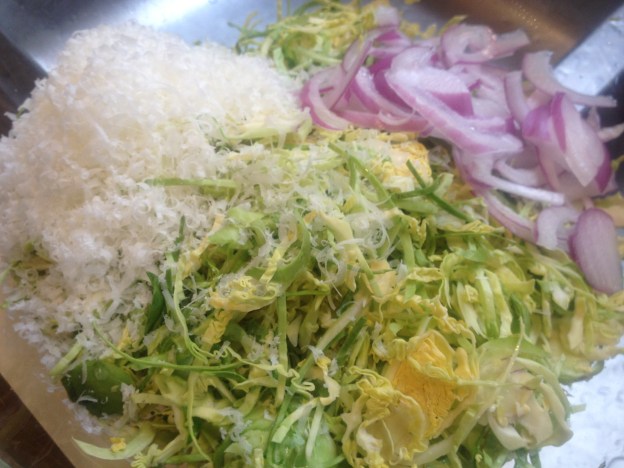
Any Brussels Sprout Salad is going to start with Brussels sprouts, in this case about 1/2 lb., finely shredded.  (I used the thin slicing blade of my food processor.)  Thinly slice 1/4-1/2 of a small red onion and let it soak in cold water while you make the rest of the salad.  In a small bowl, mix 2 Tbsp. lemon juice, 1 tsp. honey, 1 tsp. whole grain mustard, and a few grinds each of salt and pepper.  Whisk to dissolve honey, then whisk in 1 Tbsp. olive oil and whisk again until the dressing emulsifies.  Pile your Brussles sprouts and drained red onion into a salad bowl, toss with dressing, then add 2 oz. finely grated pecorino cheese and toss again.  Taste and adjust (more lemon?) if that seems like a good idea.

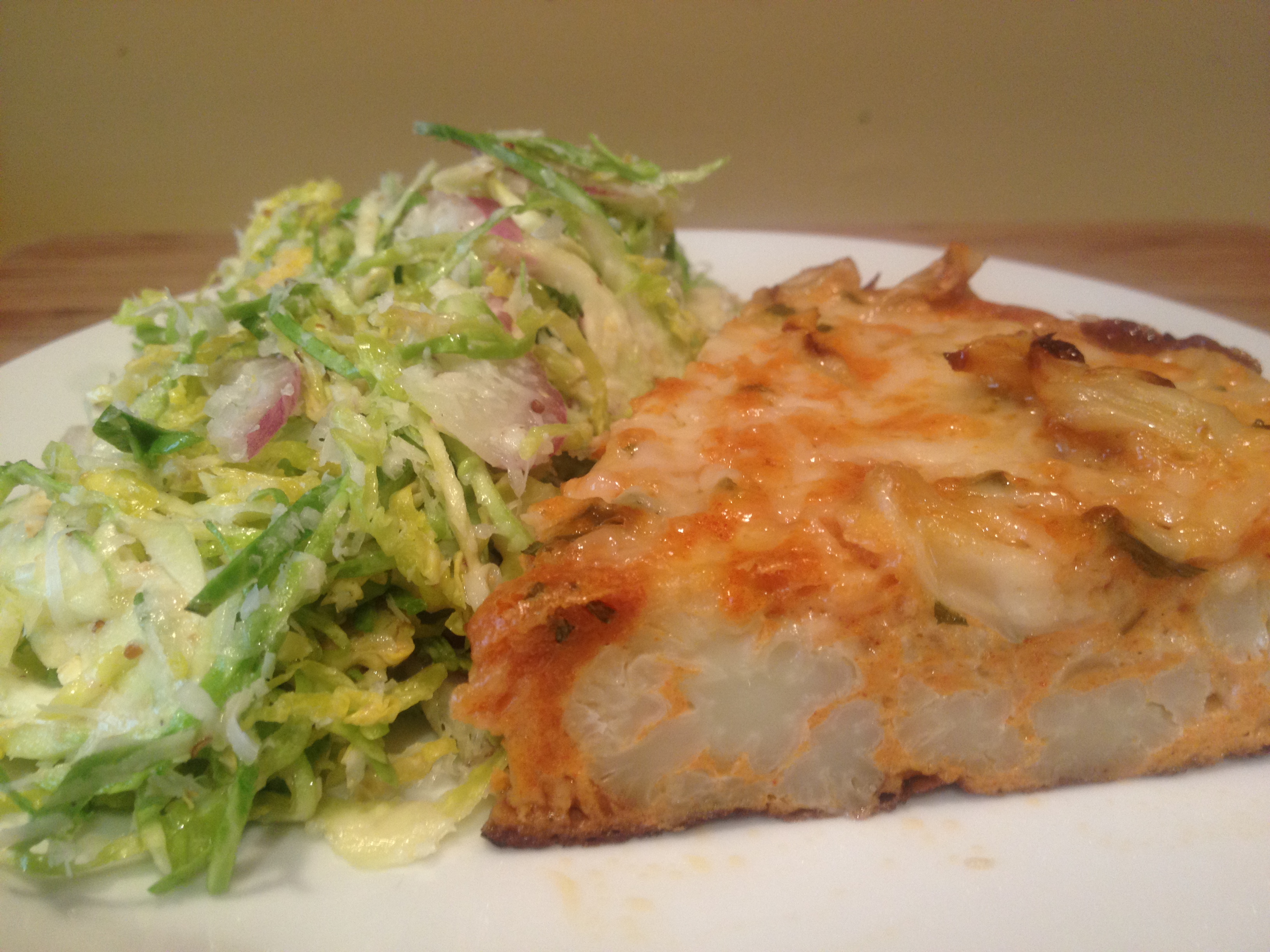
The original recipe says that this salad serves six, but I will get personal here and let you know that J and I polished the whole thing off by ourselves for lunch, alongside a wedge of Smoky Cauliflower Frittata.  I told you we’d be making that again soon. 

Roasted Tomatoes, or, How to Coax Summer Flavor from Winter Tomatoes

Winter tomatoes, blah, we all know that.  At least in these latitudes.  When I visited California in December, my mom had a 10-foot Roma tomato plant that had climbed beyond its trellis into the apple tree and was still fruiting as it reached for the winter sky.  Here in Seattle, I can barely get a tomato to ripen in my back yard in September.  But that’s a different story.

This is not, mind you, a recipe for turning a winter tomato into a summer tomato.  There is nothing you can do in mid-February to turn a hard, lifeless winter tomato into the juicy, fragrant, wonderous thing that a summer tomato is.  This is a recipe for something different altogether.  Something jammy and sweetish, but with the acid undertones of tomato flavor.  Something with a little chew and a little luscious pulp and juice.  Something you will want to eat a lot of.

In the summertime, I like to buy tomatoes by the box to roast and freeze for winter.  We use them all year on pizzas, in soups and pastas and sandwiches, in pots of white beans.  They’re great with roasted garlic, or smeared onto a piece of toast with fresh goat cheese.  But eventually we run out.  These roasted tomatoes can be used in all the same ways.

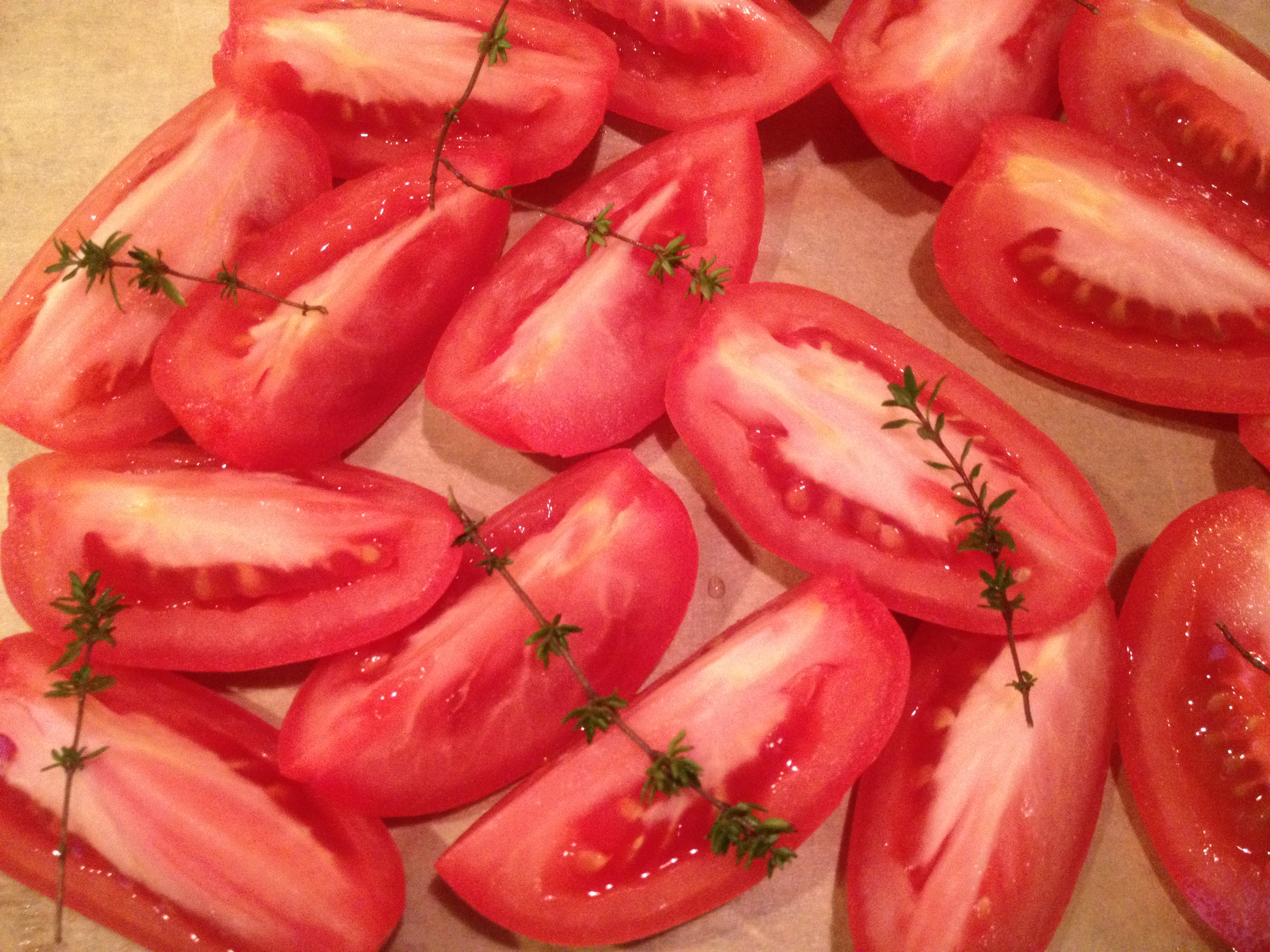
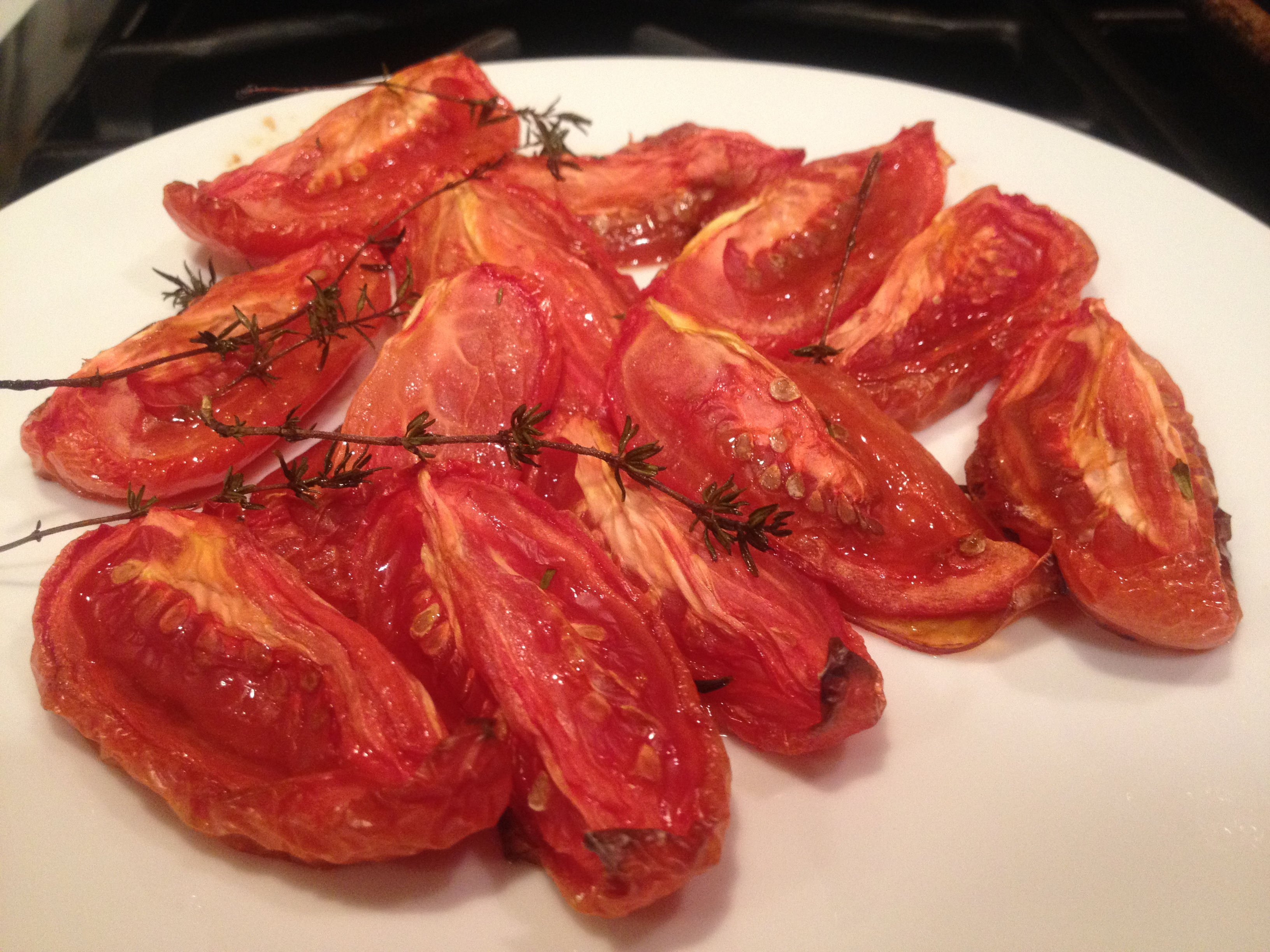
Roasted Tomatoes take some time, so start early or make a batch on the weekend to use throughout the week.  Quarter Roma tomatoes and place them on a baking sheet with a handful of thyme sprigs.  Drizzle with olive oil and a little balsamic vinegar, which will sweeten as it reduces, and sprinkle lightly with salt.  Bake at 275 for a long, long time.  Maybe two hours.  You want the edges to begin to brown and the bodies to collapse into a succulent, semi-dried state.  Taste one.  If it is watery, or if it still says winter tomato to you, leave it in a bit longer.

These tomatoes would be darn tasty, come to think of it, on yesterday’s homemade spinach pasta.  We’ll have to make that again soon.