Tag Archives: recipes

Vegetarian Enchilada Bake with Black Beans and Tofu

The part of me that enjoys nourishing others is mightily satisfied when I make a casserole.  I know it seems stodgy, but making a heavy pan of food meant to feed a crowd is an act of love.  Maybe that’s why casseroles were so popular in the ’70s–wasn’t love in vogue back then?

We’ll call them love enchiladas, then.  Although there are lots of other good things in here, too: sweet vegetables, a good boost of protein in the black beans, tofu, and cheese, a kick of chile and spice.  But, as usual, there are no hard and fast rules.  Use what you have.

And a love note to vegans or those in a rush: the black bean/tofu/veggie mix also makes a killer taco filling.  Vegetarian Enchilada Bake with Black Beans and Tofu: To make your enchilada filling, saute a diced onion and a diced red pepper over medium-high heat until the onion begins to brown.  Add a diced zucchini, a few cloves of chopped garlic, and some corn.  Add a few pinches of salt, a tsp. dried oregano, and a couple tsp. each of cumin and chile powder.  Stir in a few cups of black beans (with their liquid if you cooked them; drained if they’re canned) and a block of diced tofu.  (If you plan in advance, you can freeze then thaw and crumble the tofu; it gives it a nice texture.)  Add some water if necessary to keep the mixture from sticking, simmer for a few minutes to blend the flavors, then taste for salt and mix in a handful of chopped cilantro at the end.  You want the mixture fairly saucy so your casserole won’t dry out while baking.  Pour a splash of enchilada sauce into a 9×13 pan (I used a prepared one this time, but if you have time it’s always worth making your own from dried chiles).  Layer your ingredients on top of the sauce as follows: corn tortillas to cover the bottom of the pan in a single layer, 1/2 of the veggie mixture, a drizzle of enchilada sauce, a sprinkling of melting cheese, a crumble of feta cheese.  The next layer is corn tortillas, 1/2 the veggie mixture, more corn tortillas, then the rest of your enchilada sauce.  Bake covered at 350 until the enchiladas are hot and bubbling (20-30 minutes if your veggie mixture started out hot), then uncover, sprinkle the top with more of both kinds of cheese, and continue baking until the cheese melts.  You can always turn on the broiler to get the top nice and brown.  Serve with brown rice, a green salad, and lots of good toppings: chopped cilantro, sliced avocado, salsa, sour cream, and some of that amazing cilantro pesto you keep in your freezer.

 

A Child’s Sugar Cookie

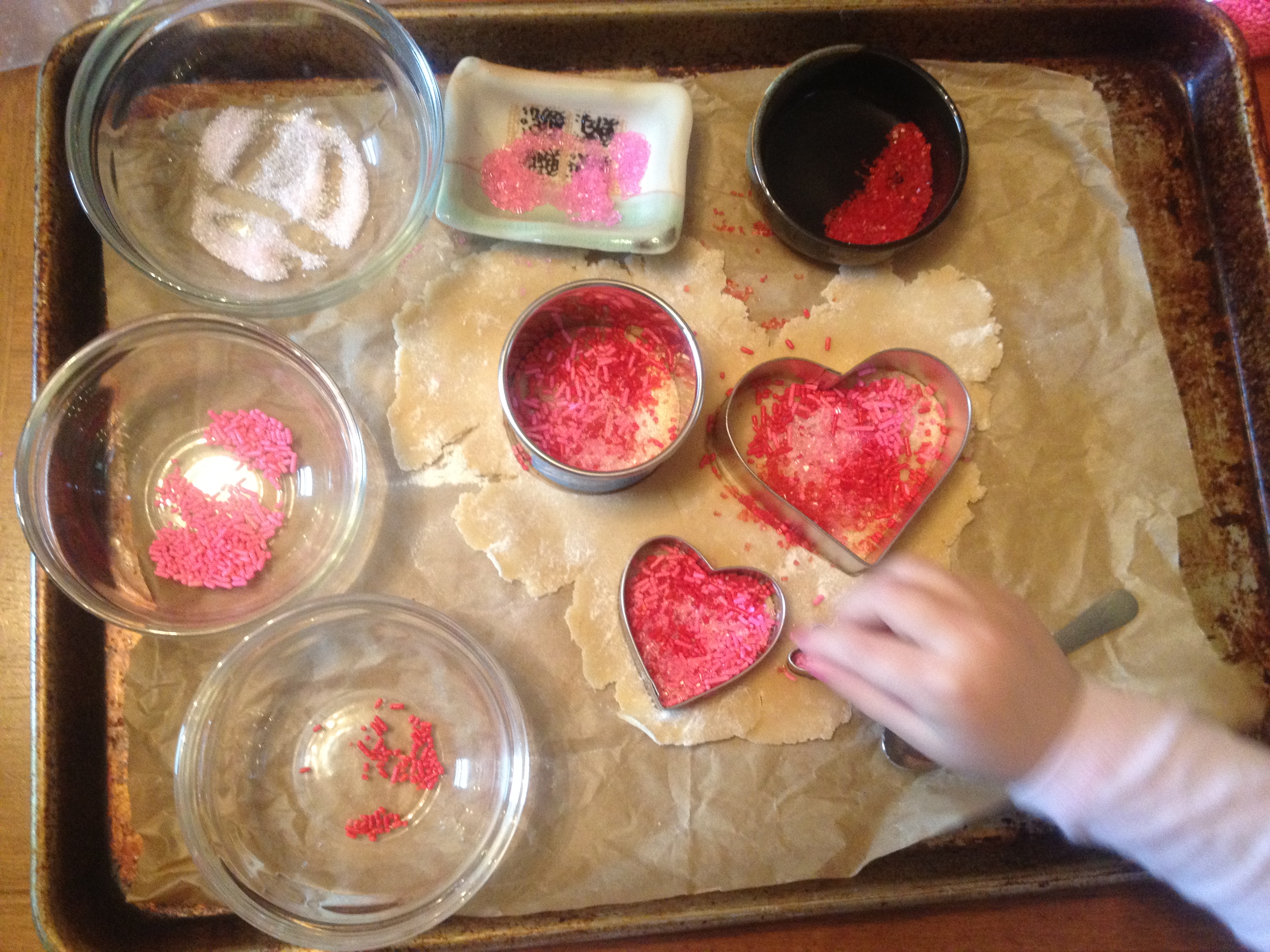
Valentines Day didn’t go exactly as planned this year.  So we put off making our usual heart-shaped cookies until everyone was well enough to be allowed back into the kitchen.  It’s never the wrong day to celebrate with pink heart cookies, I say.

I love this recipe for two reasons.  First, the dough is extremely easy to work with.  Kids can roll it, cut it, move the cookies, re-roll the scraps, and start again.  It isn’t fussy at all.  Second, the recipe came to me from my mom’s good friend, who got it from her “Mumsy” decades ago, and you know those recipes are always the best.  The recipe came labeled: “A Child’s Cookie: stands up to rough handling by kids.”  And indeed it does.

Sugar Cookies: Cream 1/2 c. butter with 1 c. sugar.  Stir in 2 beaten eggs and 1 tsp. vanilla.  Add 2 1/2 c. flour mixed with 2 tsp. baking powder and mix well.  Chill dough in refrigerator for 1 hour or up to several days.  Roll out to 1/8-1/4″ thick, using a little more flour if the dough is sticky (thicker cookies will be softer, thinner will be crisper).  Cut out shapes and bake at 350 on an ungreased cookie sheet.  Baking time will vary according to thickness, but start checking them after 6 minutes and remove from oven before they start to brown.  Cool on a wire rack.  We decorated ours with colored sugar and sprinkles before baking, but of course you can frost these and decorate them once they’re baked.   Or leave them plain–you can never go wrong turning plain thin cookies into Nutella Sandwich Cookies.

Roasted Maple Squash Soup

Some days you need something delicious in a hurry. Preferably something warm, if it’s February and you live in Seattle. Preferably soup.  In fact, hopefully you have some of this soup stashed in your freezer.  If you don’t now, you will soon.
This is the kind of soup that can turn you from a recipes-only cook into a confidently-winging-it cook.  It’s kind of foolproof that way.

Roasted Maple Squash Soup: Roast a winter squash.  Any winter squash.  Roast a few, while you’re at it.  Cut each in half, rub the cut sides with oil, bake face down on a rimmed sheet at 400 degrees until soft.  (Scoop out the seeds and save them in your freezer to make vegetable broth.)  Scoop the roasted flesh into a soup pot.  (Put the peel in the freezer with your seeds.  Mmm, homemade veggie broth.  That will be another post.)  Cover your squash with broth, maybe one that you’ve made yourself.  (Come to think of it, you could make a quick broth now with those seeds and peels: cover with water and add 3/4 tsp. salt per quart of water and maybe a chopped onion or some herbs, simmer 30 minutes and strain.)  So: roasted squash, broth, salt and maple syrup to taste.  Simmer, mash or puree the squash, adjust the seasonings.  Maybe that’s it.  Maybe you’re feeling indulgent?  Try a splash of cream or coconut milk.  Make sure you make some extra soup for the freezer.

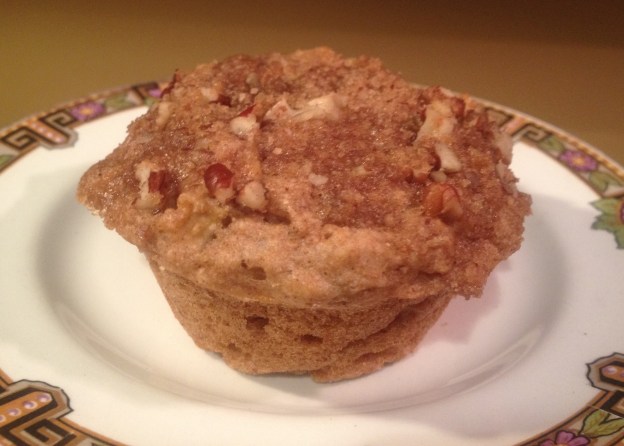
Whole Wheat Apple Muffins

Today was baking day.  Bread, cookies, granola, muffins, maybe a cake.  I had the best of intentions.  Butter softening on the counter.  Oats and nuts down from the shelves.  Sugar, honey.  All the ingredients.  And then, as it sometimes does, the day got away from me.  So that was fun too.

But I did make these muffins.  They use 100% whole wheat flour but somehow aren’t heavy.  They’re moist and a little sweet, and you can make them sweeter with a pecan streusel topping.  We always go that route when we have them as a breakfast treat.  Or you can make the muffins plain, as I do when I make them for my kids’ lunchboxes, usually in a mini muffin tin.  Kids dig little things.  And it’s cute to watch the baby enthusiastically eat a whole–if tiny–muffin.

Whole Wheat Apple Muffins require three bowls if you’re making the streusel topping, which I highly recommend.  Make the topping first: mash together or pulse in a food processor 1/2 c brown sugar, 2 tsp. flour, 1/2 tsp. cinnamon, 3 Tb. butter, and 2/3 c. chopped pecans.  Pop the topping into the freezer while you’re preparing the batter (and if you have leftover topping, you can keep it in the freezer for next time).   Mix wet ingredients in one bowl: 2 beaten eggs, 1 1/3 c. buttermilk, 1/3 c. canola oil, 1 1/2 tsp. vanilla.  Mix dry ingredients in a separate bowl: 2 1/2 c. whole wheat pastry flour, 2 tsp. baking powder, 1 tsp. baking soda, 2 tsp. cinnamon, 1/2 tsp. salt, and 1/2 c. (or up to 3/4 c.) brown sugar.  Using a rubber spatula, fold wet and dry ingredients together with 1 c. peeled and finely diced apple.  Don’t stir too much, just until it’s all combined.  Scoop into buttered or lined muffin tins, filling nearly to the top, then pat streusel on top if you are using it.  Bake at 375 in the upper 1/3 of the oven for about 10 mins for mini muffins or 20-25 mins for the larger size.

This recipe is from my all-time favorite cookbook, Deborah Madison’s Vegetarian Cooking for Everyone.  My copy is falling apart, pages are abandoning the binding, it’s oil-stained and thickened by pages that have soaked up sauces, dressings, soup splatters, and my notes in the margins.  What do your favorite cookbooks look like?  And what are they?

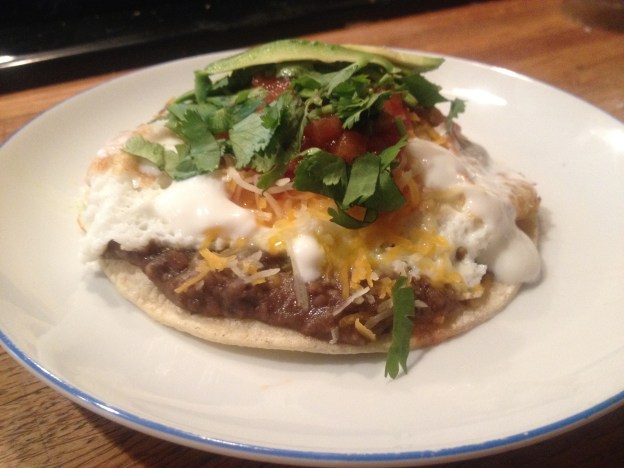
Huevos Rancheros

A leisurely breakfast is a fine thing on a weekend morning.  A pot of coffee, everyone in pajamas, a few moments to putter around in the kitchen.  These are the simple pleasures.  This breakfast is one of my favorites.

In my book, the essential elements of Huevos Rancheros are tortillas, beans, eggs, cheese, and sauce.  There are many variations, but I don’t think you can go wrong.  This is not a demanding recipe.  Use what you have.  Improvise.  Someday I will make Huevos Motulenos for you, an amazing concoction featuring a fried banana.

But back to Huevos Rancheros: first warm up a pot of beans.  If you have beans left over from making Chilaquiles, or maybe even some leftover chili, you are in business (how clever of you to have made extra for the freezer!).  Or maybe you have some of those Black Beans with Cilantro and Lime in the fridge.  If not, season your beans now: saute an onion and some garlic, tip in the beans and a little salt and water, maybe with some cumin and oregano or chipotle puree, let it all simmer while you get the rest of your toppings organized, and then mash it all coarsely with some handfuls of cilantro and a big squeeze of lime.  Meanwhile, heat tortillas on a griddle (or get traditional and fry them) and fry your eggs.  Layer a warm tortilla with beans, eggs, a scattering of cheese, salsa or chile sauce, cilantro, and avocado.  You could add a dollop of sour cream.  And do you still have some of that cilantro pesto in the freezer?  Lucky you.  Enjoy your breakfast.

Roasted Cauliflower

Yesterday got me thinking about flavorful vegetarian cooking.  I have been a vegetarian (or, now, a mostly-vegetarian, with apologies to those who are offended by the concept) for my entire cooking life.  So I have never relied on meat to flavor my food.  What do I rely on?  Vegetables, heat applied to vegetables, fat, salt, spices and herbs.  I also know and revel in the range of textures and flavors that each vegetable can provide on the plate: a beet can be meltingly sweet and earthy or brightly crisp and bracingly imbued with lemon or ginger.  Fennel can be a licorice tangle of crunch, a whisper of greens in a salad, or carmelized to a sweet and savory mush that is barely haunted by anise flavor.  And I get excited every time I discover a novel way to cook a vegetable.

By way of illustrating the range of a humble vegetable, I thought I’d share a very simple but utterly delicious recipe for roasted cauliflower.  Compare it to this simple, creamy 5-ingredient Cauliflower Soup (cauliflower, onion, olive oil, water, salt).  Compare it to this Smoky Cauliflower Frittata.  You can take a cauliflower in a lot of directions.  But once it’s roasted, that’s pretty much the end of the line for a cauliflower in our house.  It often gets eaten off the sheet pan before dinner is even on the table.

Roasted Cauliflower: Chop one head of cauliflower (or two, if you want one left to put on the table with dinner) into medium florets, and chop the remaining stem into slightly smaller pieces.  If the leaves are large, chop them as well, otherwise leave them whole.  Pile onto a roasting pan, including the tiny bits–these will brown into delicious little salty bites.  Toss with olive oil and salt and roast at 450.  Turn with a tongs after 20 minutes, then every 10 minutes after that, until they are nice and brown on all sides (about 45 minutes total).  Hide from passers-by until serving.


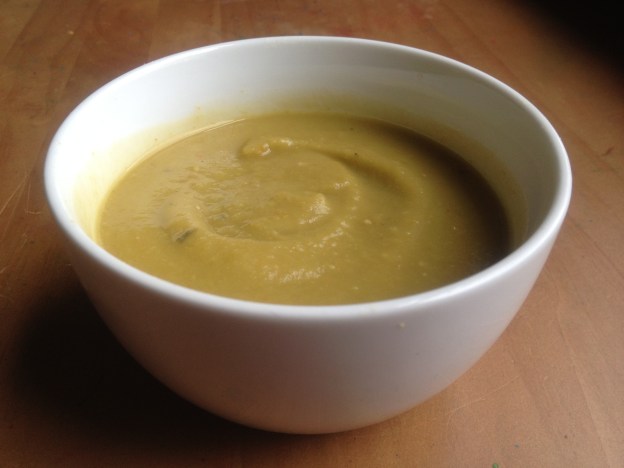
Vegetarian Split Pea Soup

I like to have a pot of soup around.  It can be simmering on the stove or left over in the fridge or even packed away in the freezer–I just like to know it’s there.  I eat a lot of soup.  It’s a quick lunch, an easy dinner, and you can always double the recipe to feed even more of the people you love.  (But let’s be clear: I almost always double the recipe whether company’s coming or not.  See above.)

I make lentil and bean soups often but, strangely, I don’t think I had ever made split pea soup before this week.  You know why? Because the recipes always call for an “optional” ham hock.  Whatever that is.  And I can never believe that recipes calling for “optional” meat are going to be any good if you leave the meat out.   I automatically skip over any recipe that calls for bacon and then implies that the vegetarian version will be just as good if you simply omit the bacon.  The bacon is the FLAVOR in that recipe, and a good vegetarian recipe builds flavors in a different way, through spices and cooking technique.

But when I made that Smoky Cauliflower Frittata recently and J said it tasted meaty, I had the obviously-delayed epiphany that the flavors that bacon and ham hocks add are smoke and salt.  I was ready to make split pea soup.  I went right to the source for my recipe: Pea Soup Andersen’s Facebook page.  This recipe is vegetarian in the original, but just to be on the safe side–in case those ham hock recipes are on to something–I replaced the cayenne with hot smoked paprika anyway.

This just the kind of recipe I like: simple, flavorful, hearty. I doubled the recipe, of course, but I supposed you don’t HAVE to.  (A double recipe made a truly huge pot of soup.  The original recipe says it makes 8 bowls, which is a regular-big pot of soup.) 

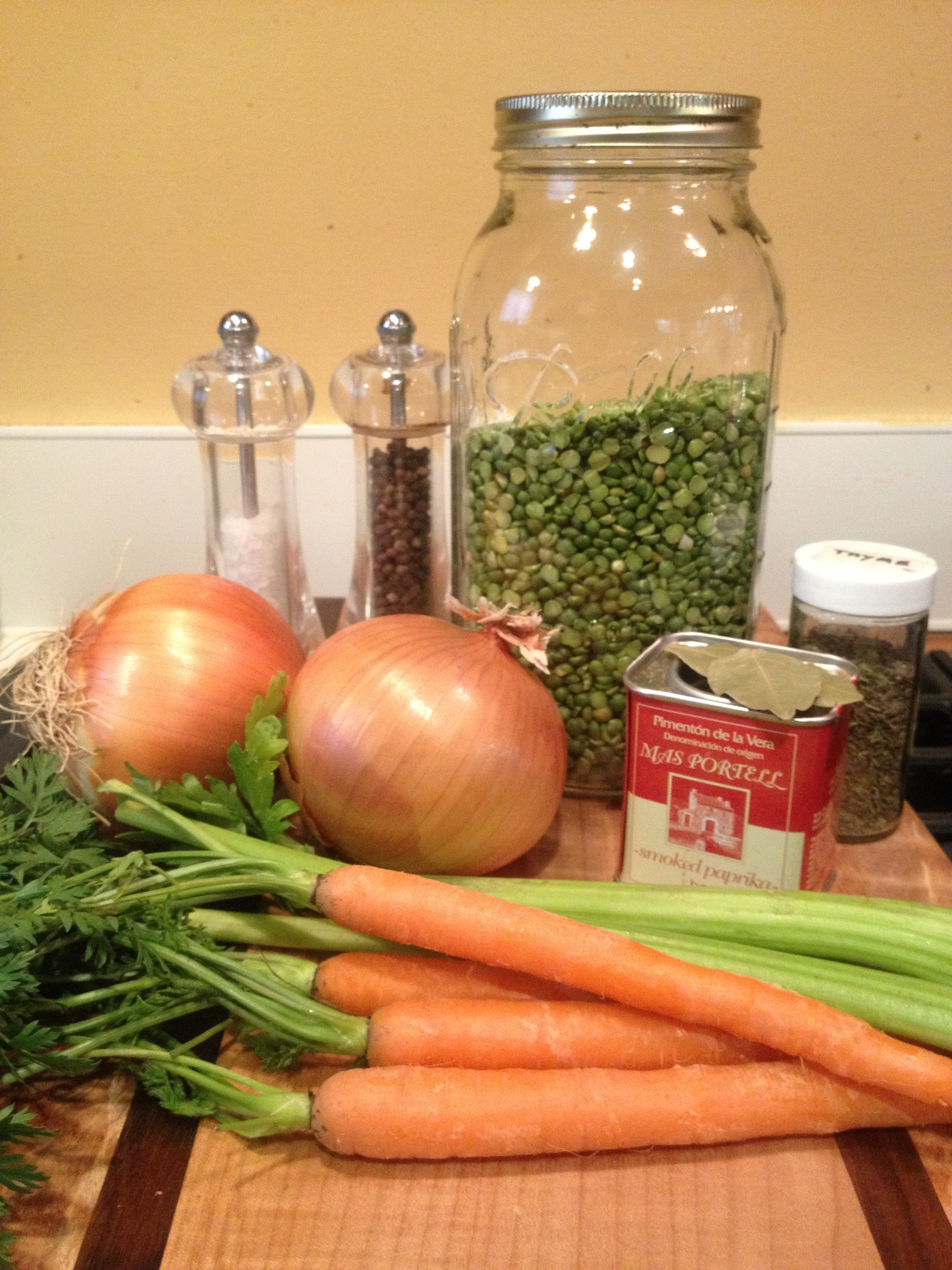
To make a regular-big (not truly huge) pot of Vegetarian Split Pea Soup, dice a large onion, a large carrot and a celery stalk and saute in olive oil until the vegetables soften and the onion is translucent.  Add 1/4 tsp. dried thyme and 1/2 tsp. smoked paprika and stir, then add 2 c. sorted and rinsed green split peas, 8 c. water, a bay leaf and 1 1/2 tsp. salt.  Maintain a peppy boil for 20 mins, then reduce heat and simmer until the split peas are very soft, probably about an hour in all, stirring occasionally.  Season with salt and pepper.  I originally planned to puree the soup, but once I cooked the peas down to mush I loved that texture too.   It tastes great both ways, but I think the pureed version looks a little more elegant.

If you want to get fancy, you could top the soup with another sprinkle of smoked paprika or some homemade croutons.  Or serve it with a nice easy bread or homemade rye crackers.  Or just keep it in the fridge to reheat (thinned with a little water) for lunch this week.

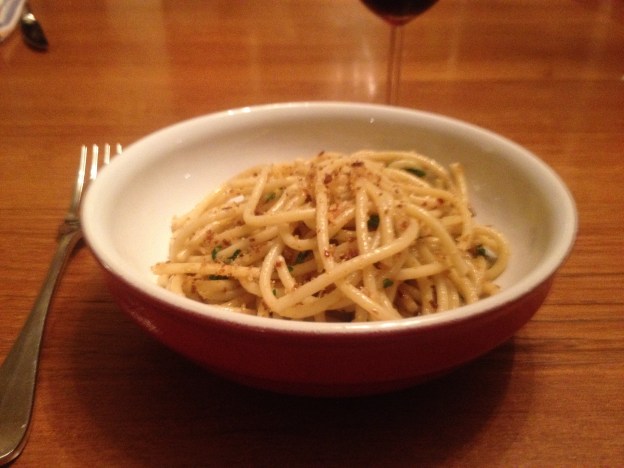
Pasta with Garlic, Anchovies, Chili and Breadcrumbs

Sometimes things don’t go according to plan.  I am going to have to update my tagline: “daily recipes…except when I have two sick kids.”  I am also revising my Valentines Day plans for the same reason.  Out with the heart-shaped foods and chocolate desserts.  In with a dinner that takes 25 minutes to make but still says “I love you.”

This recipe is one of J’s favorites.  It comes from one of our favorite Seattle restaurants, Anchovies and Olives, where it is “Bigoli with Garlic, Chili, and Anchovy.”  If you want to make bigoli, more power to you.  If you want a similar-shaped dry pasta, you can use bucatini.  If you want the texture of a fresh pasta, which I do like with the crispy breadcrumbs, you could use any long noodle.  If you just have a box of spaghetti in your cabinet, get it out, it will be great.

Pasta with Garlic, Anchovies, Chili and Breadcrumbs: Put a big pot of water on high heat, and add salt and 1 lb. pasta when it boils.  In a separate small pan, make garlic-infused breadcrumbs by gently heating a couple Tbsp. olive oil with a few smashed cloves of garlic.  Meanwhile, pulse and then grind a few slices of bread to crumbs in your food processor.  Remove the golden cloves of garlic from the oil and enjoy them on chunk of bread while you continue cooking (you have a glass of wine, too, maybe?)–or share them with your Valentine.  Toss the fresh breadcrumbs into the garlic oil and stir occasionally over low heat until they are golden and crisp.  Season with salt and set aside.  Once the breadcrumbs get started in the garlic oil, get another pan (this one big enough to hold the finished dish) on the stove.  Heat 1/4 c. olive oil over medium-low heat with three sliced cloves of garlic, 1 tsp. chili flakes and 12 drained and chopped oil-packed anchovies.  Stir occasionally until the garlic softens and the anchovies melt into the oil.  When your pasta is nearly cooked to your liking, drain and add it to the anchovy sauce pan with 1/4 c. chopped parsley. Toss and continue cooking until pasta is perfectly cooked, tasting and adjusting with more oil or chili flakes if you like.  Serve each bowl topped with a generous spoonful of breadcrumbs.

If you want to gild the lily, you can serve this dish (or your reheated leftovers) topped with a fried egg.

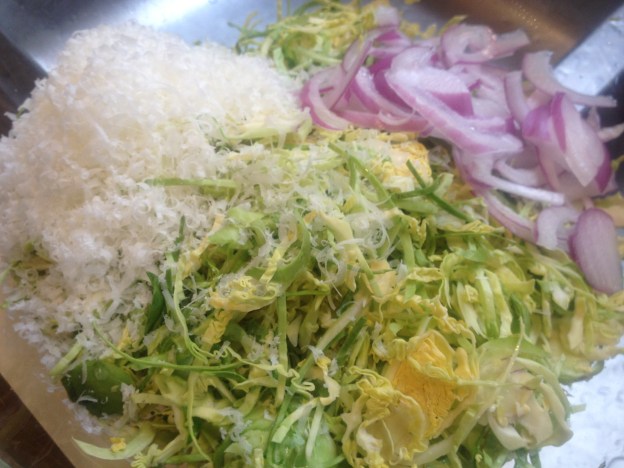
Shaved Brussels Sprout Salad with Lemon, Pecorino and Red Onion

The other day I got to sneak away to one of Seattle’s year-round farmers markets for an hour with a friend.  I hadn’t been to a farmers market for a while and apparently felt that I had to make up for lost time.  I came home with some of my favorite hazelnuts, many pounds of potatoes, rutabagas and turnips, sweet crisp apples, a new supply of Nash’s field peas, and a big bag of Brussels sprouts.  Big.

I’ve had my eye on this salad for a while, and I’m happy to report that it did not disappoint.  The version below is adapted from the Food 52 website, and I’ve updated the recipe title to reflect my own preference for the order in which the flavors should dominate.  As always, one of the joys of cooking at home is that you get to tweak every dish to taste perfect to you.  Go ahead, pile on the cheese or leave the onion out altogether.  You’re the cook.

Any Brussels Sprout Salad is going to start with Brussels sprouts, in this case about 1/2 lb., finely shredded.  (I used the thin slicing blade of my food processor.)  Thinly slice 1/4-1/2 of a small red onion and let it soak in cold water while you make the rest of the salad.  In a small bowl, mix 2 Tbsp. lemon juice, 1 tsp. honey, 1 tsp. whole grain mustard, and a few grinds each of salt and pepper.  Whisk to dissolve honey, then whisk in 1 Tbsp. olive oil and whisk again until the dressing emulsifies.  Pile your Brussles sprouts and drained red onion into a salad bowl, toss with dressing, then add 2 oz. finely grated pecorino cheese and toss again.  Taste and adjust (more lemon?) if that seems like a good idea.

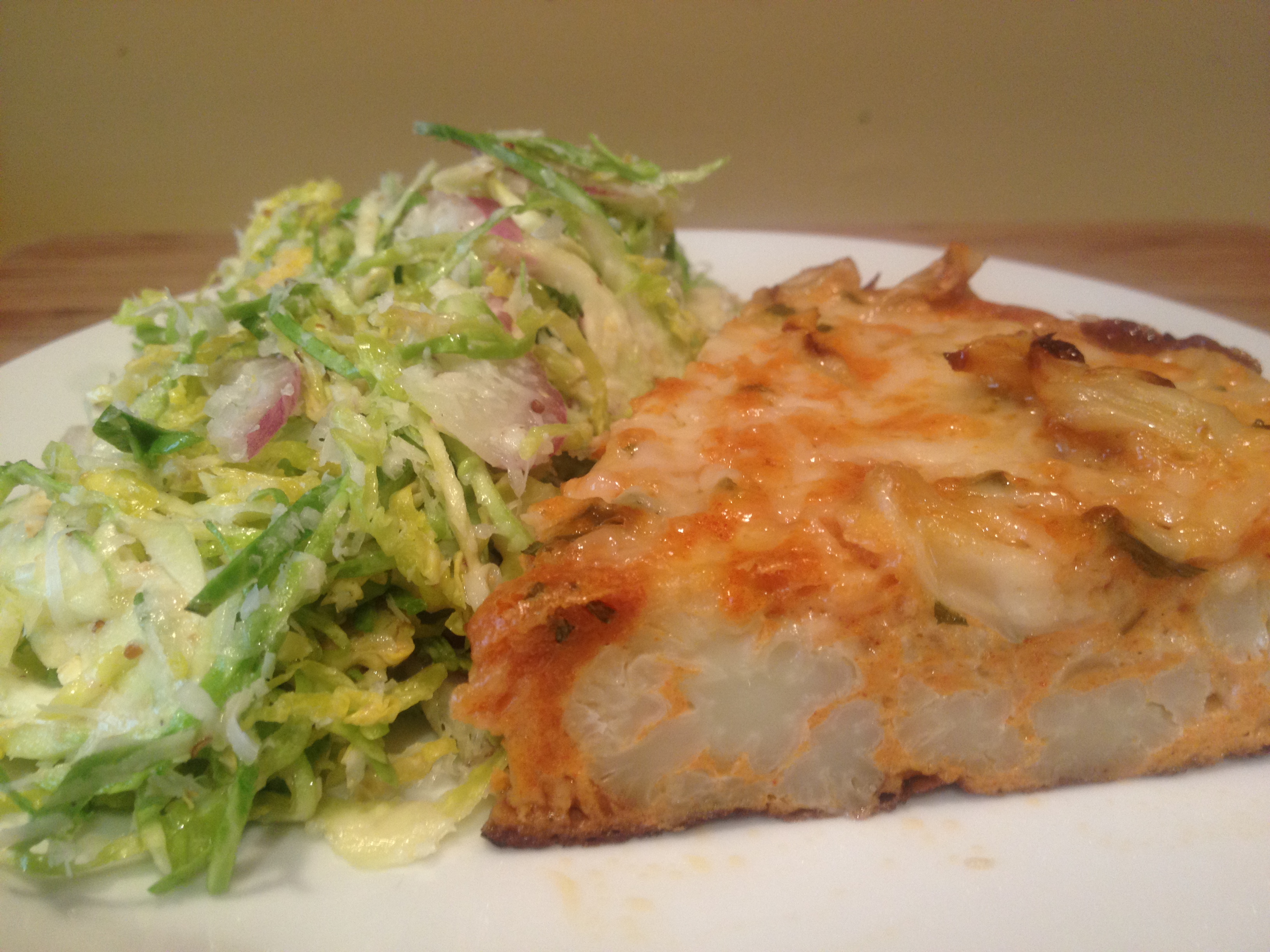
The original recipe says that this salad serves six, but I will get personal here and let you know that J and I polished the whole thing off by ourselves for lunch, alongside a wedge of Smoky Cauliflower Frittata.  I told you we’d be making that again soon. 

Homemade Rye Crackers with Apricot-Chevre Spread

Welcome to Emmy Cooks!  You can see some of my favorite recent recipes by clicking the “My Favorite Recipes” category on the sidebar (here are June, July, and August).  If you like what you see here, you can sign up on the sidebar to receive a daily recipe by email, or follow Emmy Cooks on Facebook, Twitter, or Pinterest.

I buy a lot of foods in bulk from my local co-op.  I think they are cheaper and maybe fresher that way, with much less wasted packaging.  But I never considered a benefit that I was missing out on when I skip the packaging: the recipes on the back of the bag!

Circumstances (read: laziness, since I didn’t want to make an extra grocery stop) recently required me to pick up an already-packaged bag of Bob’s Red Mill Dark Rye Flour.  I like to have rye flour on hand because I use it in my pizza dough and in bread, and someone recently made me delicious Finnish rye cookies that I want to try out soon.  And that’s how I discovered these rye crackers.

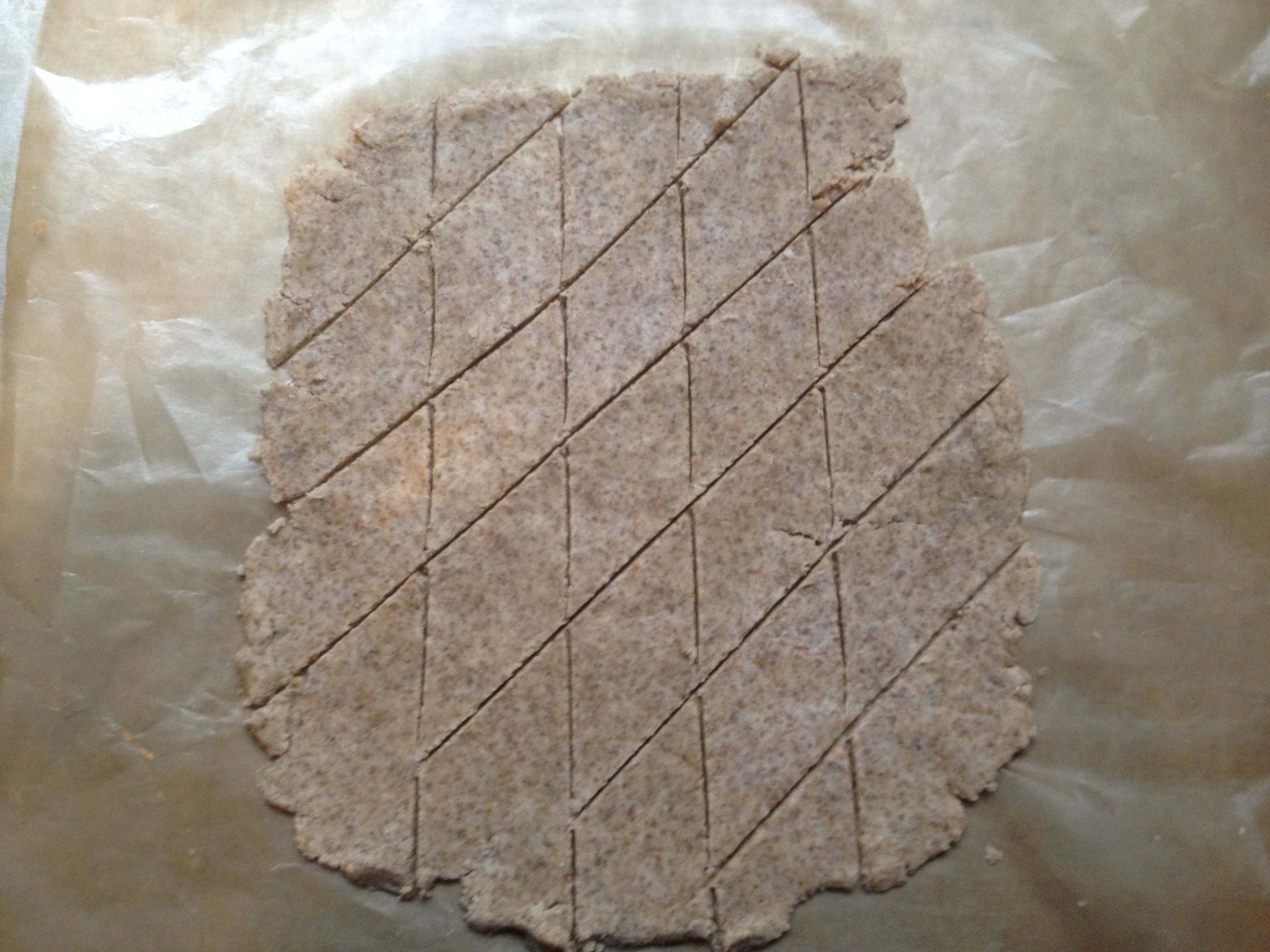
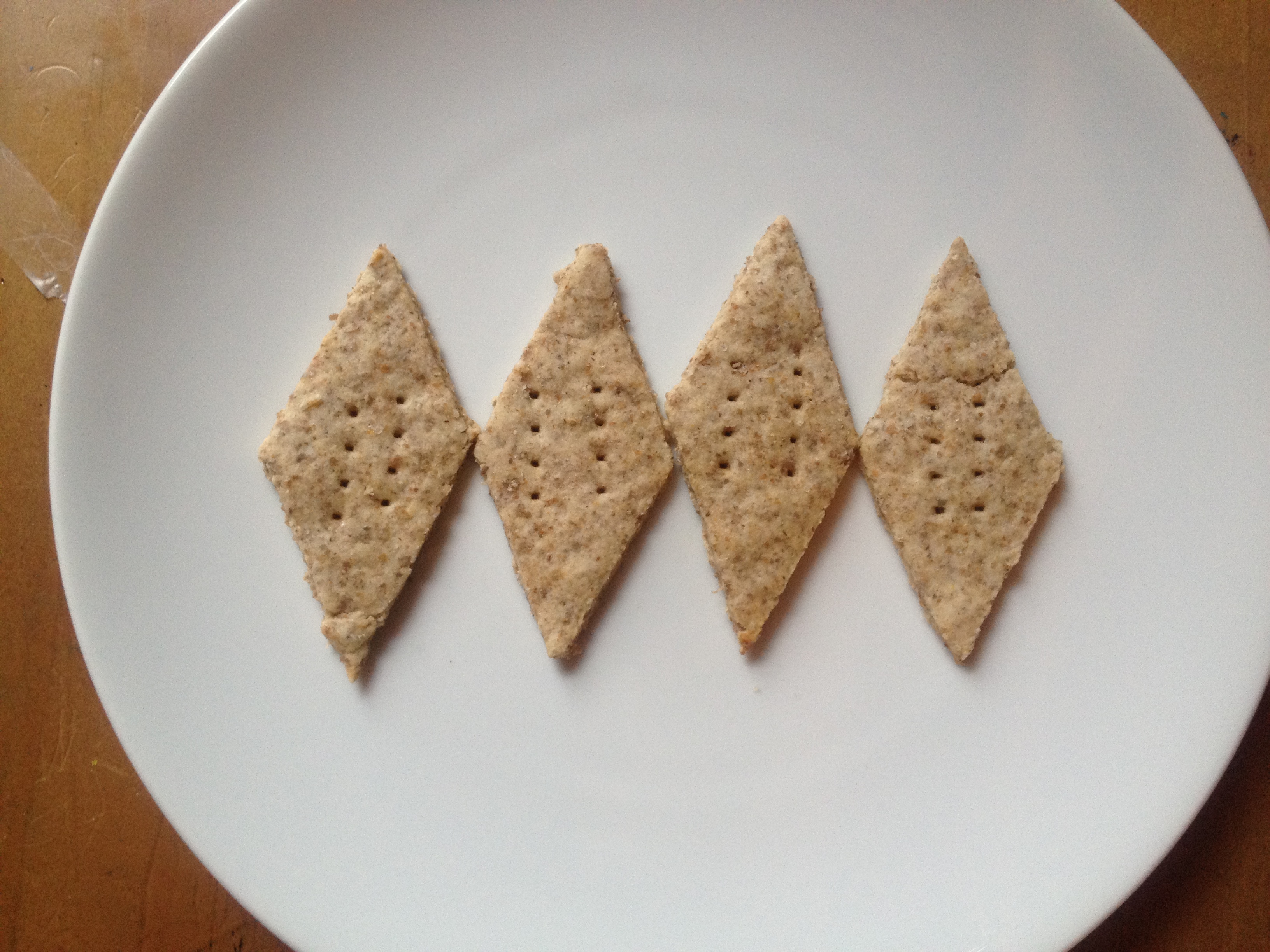
This recipe is straight from the back of the Bob’s Red Mill bag.  The crackers are thin and crisp and make a lovely little snack by themselves.  I can imagine serving them alongside a big bowl of cabbage and white bean soup.  But today we ate them in the early evening, topped with a jammy smear of apricot-chevre spread, with a glass of sparkling wine and some good friends.  I thought the combination was rather nice, myself.

To make Rye Crackers: In a medium bowl, mix 1/2 c. all-purpose flour, 1/2 c. rye flour, 1/2 tsp. salt, 1 Tbsp. Turbinado sugar, 1 tsp. baking powder and 2 tsp. caraway seeds.  Add 4 Tbsp. butter and work into the dough until crumbly (I recommend using your hands to pinch and rub the butter into the dry ingredients).  Stir in 3 Tbsp. milk.  Form dough into two balls and roll each out to 1/8-1/16 inch thickness between two sheets of waxed paper.  Cut into desired shapes and prick with a fork.  Bake at 400 degrees on ungreased cookie sheets for 5-8 mins (depending on how thin you rolled them) until edges begin to brown.  Cool on rack and, in the unlikely event that you have leftovers,  store them in an airtight container.

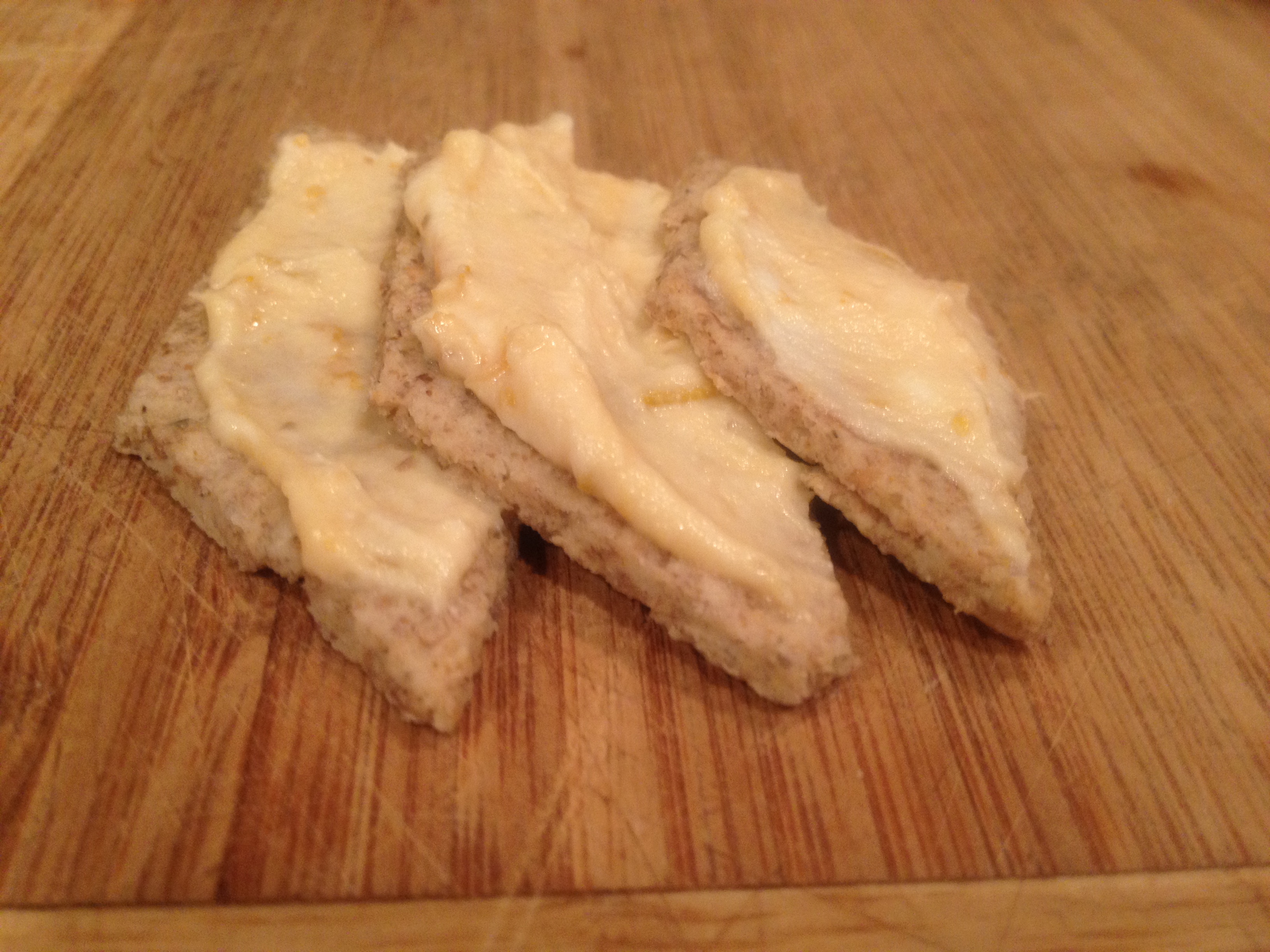
We enjoyed these crackers with an apricot-chevre spread, which was simply a few good spoonfuls of homemade apricot jam stirred into a few oz. of soft goat cheese.  I’m sure they’d also be good with a sharp cheddar, soft havarti, or blue cheese.